Monthly Current Affairs: August 2026 – major news for UPSC
Monthly Compilation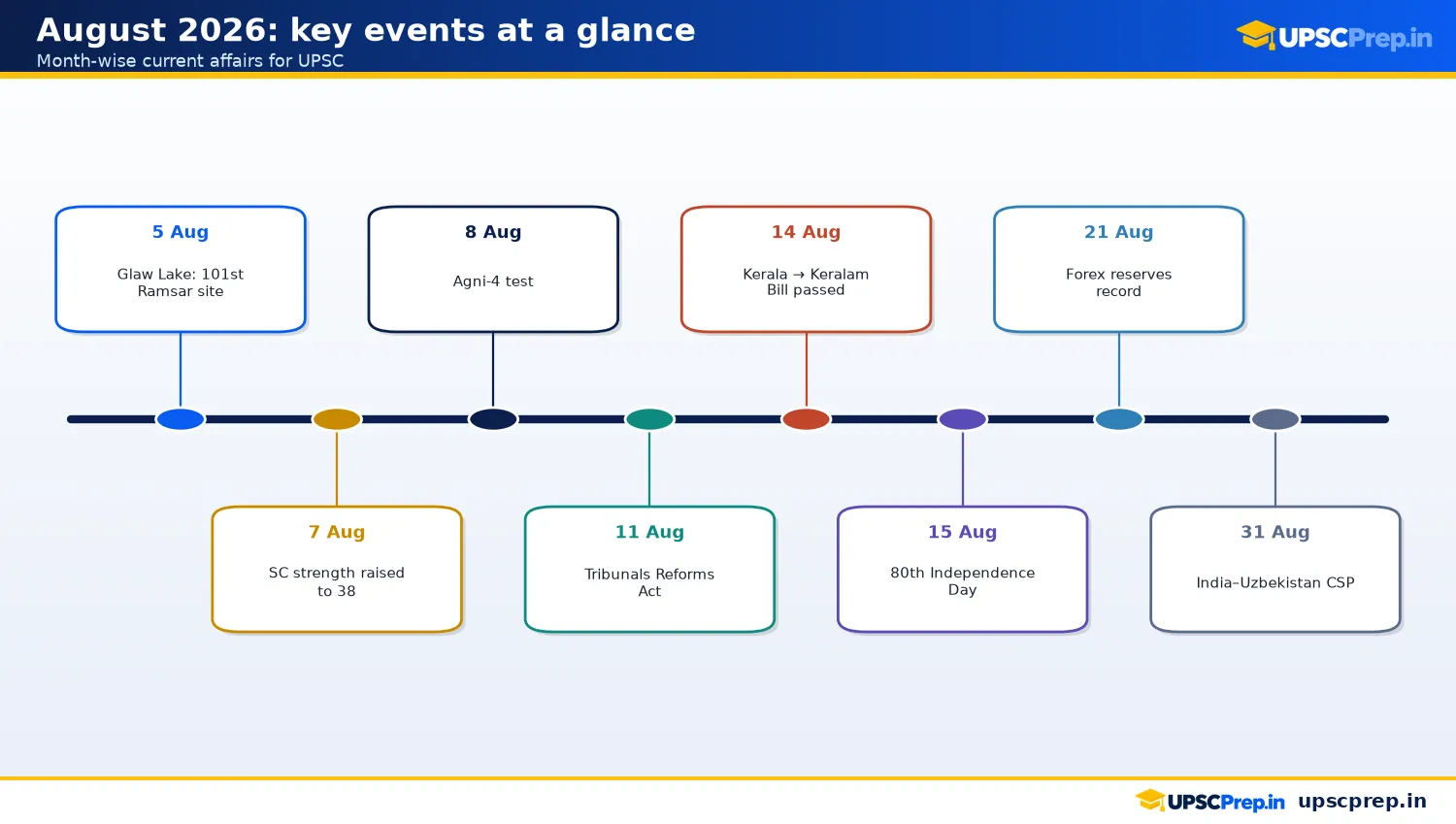
August 2026 was a busy Monsoon Session month: Parliament passed laws on Kerala's name, tribunals, mining taxes and Supreme Court strength, while India marked its 80th Independence Day. Here are the major items, grouped by GS paper.
In this compilation: 34 major items, grouped by GS theme · 10-question quiz at the end.
Timeline: key events of August 2026
Places in news, August 2026
Polity & Governance
1. Parliament passes Bill to rename Kerala as "Keralam"
- The Kerala (Alteration of Name) Bill, 2026 was passed after a unanimous resolution of the Kerala Assembly.
- Under Article 3, Parliament can change a state's name; the state legislature's views are sought first.
- "Keralam" is the state's name in Malayalam.
Why it matters for UPSC: Article 3–4 procedure (simple majority, not a constitutional amendment under Article 368) is a Prelims favourite.
Syllabus: GS2 – Union and its territory
2. Supreme Court strength raised to 38 judges
- The Supreme Court (Number of Judges) Amendment Bill, 2026 raised sanctioned strength from 34 to 38, including the CJI.
- Under Article 124(1), Parliament can change the number of judges by law.
- It was passed as a Money Bill, which drew debate about bypassing the Rajya Sabha.
Why it matters for UPSC: Links to judicial pendency and the Money Bill controversy (Article 110; Rojer Mathew case).
Syllabus: GS2 – Judiciary
3. Tribunals Reforms Act, 2026
- The Act replaces the Tribunals Reforms Act, 2021.
- It sets up a National Tribunals Commission to oversee appointments and service conditions of tribunal members.
- The Supreme Court had long asked for an independent body to manage tribunals.
Why it matters for UPSC: Tribunals (Articles 323A and 323B), their independence and the Madras Bar Association cases.
Syllabus: GS2 – Tribunals
4. Registration of Births and Deaths (Amendment) Bill, 2026
- The Lok Sabha passed the Bill amending the Registration of Births and Deaths Act, 1969.
- It builds on the 2023 amendment that made digital birth certificates a single proof of date of birth.
- Registration data feeds national and state databases.
Why it matters for UPSC: Civil registration links to Census 2027, welfare delivery and the NPR.
Syllabus: GS2 – Governance
5. FCRA Amendment Bill sent to a Joint Parliamentary Committee
- Both Houses referred the Foreign Contribution (Regulation) Amendment Bill, 2026 to a JPC.
- The MHA also notified FCRA Amendment Rules, 2026 on compliance and transparency.
- The FCRA, 2010 regulates foreign funding to NGOs and individuals.
Why it matters for UPSC: NGO regulation versus freedom of association is a frequent Mains theme.
Syllabus: GS2 – Civil society
6. District Collectors to grant citizenship under Section 6B
- The MHA moved pending CAA applications from empowered and district committees to District Collectors in specified border states and UTs.
- Section 6B, added by the Citizenship (Amendment) Act, 2019, covers eligible migrants from Afghanistan, Bangladesh and Pakistan.
- The aim is faster processing.
Why it matters for UPSC: CAA, Articles 5–11 and modes of citizenship are core Polity topics.
Syllabus: GS2 – Citizenship
7. MMDR Amendment Bill, 2026 limits state levies on minerals
- A new law passed by Parliament puts a ceiling on what states can levy on mineral rights and on land holding minerals.
- It aims at a uniform, predictable tax regime for miners.
- Critics say it narrows state fiscal powers after the Supreme Court's 2024 ruling that states can tax mineral rights.
Why it matters for UPSC: Links to the Mineral Area Development Authority case (2024) and fiscal federalism.
Syllabus: GS2/GS3 – Federalism, mining
8. SC: cruelty law can protect women in live-in relationships
- In Dr. Lokesh B.H. v. State of Karnataka (2026), the Court ruled that a live-in couple whose bond is marriage-like is covered by the anti-cruelty provision.
- Section 498A IPC is now Section 85 of the Bharatiya Nyaya Sanhita.
- It aligns criminal law with the Domestic Violence Act, 2005.
Why it matters for UPSC: Gender justice and evolving family law; useful Mains example.
Syllabus: GS2 – Women's rights
9. Supreme Court steps to curb "digital arrest" scams
- The Court directed the Centre, states, RBI, telecom bodies and police to act together.
- The RBI has four weeks to frame a standard procedure for briefly freezing debits on suspicious accounts.
- In such scams, fraudsters pose as officials and "arrest" victims over video calls to extort money.
Why it matters for UPSC: Cyber fraud, I4C and the role of banks in victim protection.
Syllabus: GS3 – Cybersecurity
10. Legal Metrology (Indian Standard Time) Rules, 2026
- The rules make IST the single mandatory time reference for legal, official and commercial use.
- They take effect 180 days after notification.
- IST is maintained by CSIR-NPL, New Delhi.
Why it matters for UPSC: Time sync matters for telecom, power grids, finance and cybersecurity.
Syllabus: GS2 – Governance
International Relations
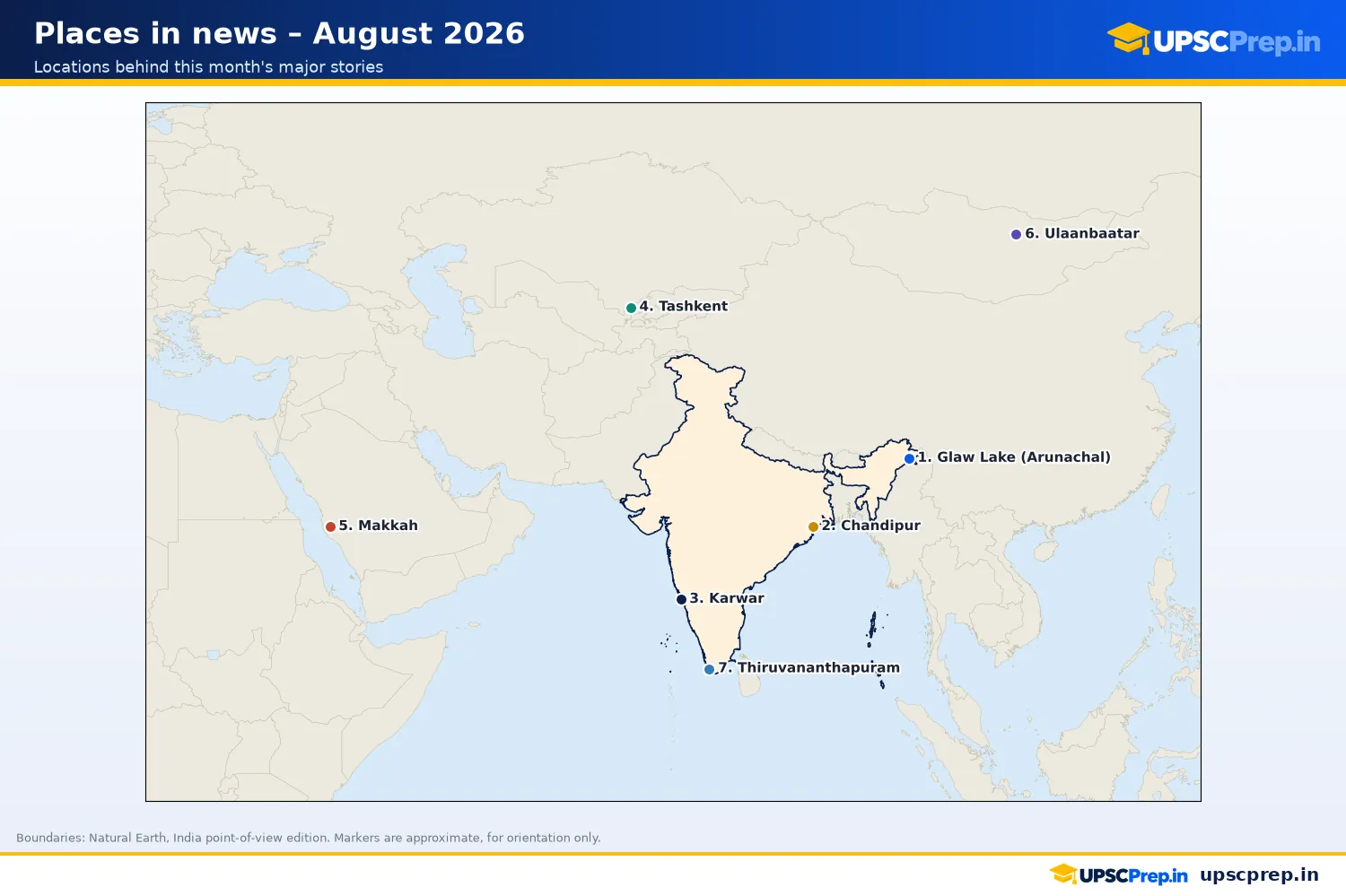
11. India–Uzbekistan upgrade to Comprehensive Strategic Partnership
- The PM's state visit marked 15 years of the 2011 Strategic Partnership.
- Ties were raised to a Comprehensive Strategic Partnership.
- Focus areas include connectivity, energy, critical minerals and security.
Why it matters for UPSC: Central Asia policy, Chabahar and INSTC connectivity.
Syllabus: GS2 – Central Asia
12. India–Japan maritime security arrangement
- The two Defence Ministers signed a Memorandum of Arrangement on maritime security in New Delhi.
- It deepens information sharing and naval cooperation.
- Both are Quad partners.
Why it matters for UPSC: Indo-Pacific strategy and the Quad.
Syllabus: GS2 – Indo-Pacific
13. Saudi Arabia, Türkiye and Pakistan sign the Makkah Joint Defence Agreement
- An armed attack on one will be treated as an attack on all three.
- It was signed at Al-Safa Palace in Makkah.
- It has been called a new "triple alliance".
Why it matters for UPSC: Implications for India's ties with the Gulf and its security calculus vis-à-vis Pakistan.
Syllabus: GS2 – West Asia
14. India formally names 27 places in Arunachal Pradesh
- The Survey of India marked 27 locations on its official map.
- It responds to China's lists renaming places in Arunachal (2017, 2021 and later).
- India calls Chinese renaming "cartographic aggression" with no effect on facts.
Why it matters for UPSC: Boundary disputes and the LAC are core India–China topics.
Syllabus: GS2 – India–China
15. UNSC second straw poll for the next UN Secretary-General
- Guterres' second term ends on 31 December 2026.
- Under Article 97 of the UN Charter, the General Assembly appoints the Secretary-General on the Security Council's recommendation.
- Straw polls among Council members narrow the field.
Why it matters for UPSC: UN structure and reform are frequent GS2 themes.
Syllabus: GS2 – UN
Economy
16. Merchandise exports jump nearly 20% in July 2026
- Exports reached USD 44.2 billion in July 2026.
- Growth came despite West Asia turmoil, helped by market diversification.
- Data comes from the Ministry of Commerce and Industry.
Why it matters for UPSC: Export diversification and trade resilience for Mains.
Syllabus: GS3 – Trade
17. Forex reserves hit a record USD 729.33 billion
- The record was reached as of 21 August 2026.
- An RBI concessional swap window for FCNR(B) deposits drew dollar inflows.
- Bigger reserves help the RBI steady the rupee.
Why it matters for UPSC: Know the components of forex reserves and the 2013 FCNR(B) swap precedent.
Syllabus: GS3 – External sector
18. Polymer banknotes approved for field trials
- The government approved an RBI proposal under Section 25 of the RBI Act, 1934.
- Polymer notes last longer and are harder to counterfeit than paper notes.
- Field trials will test their use in Indian conditions.
Why it matters for UPSC: Section 25 gives the Centre power to approve note design; good Prelims fact.
Syllabus: GS3 – Currency
19. CBDC-based DBT for food subsidies
- A digital-rupee DBT system was launched for food subsidy under PMGKAY.
- Chandigarh and Dadra & Nagar Haveli were the first UTs to cover all eligible beneficiaries.
- Programmable e-rupee can be limited to buying food grains.
Why it matters for UPSC: Shows uses of the e₹ beyond payments; links to leakages in PDS.
Syllabus: GS3 – Digital public infrastructure
20. RBI to resume licensing urban cooperative banks
- The RBI will restart "on-tap" licensing of UCBs.
- New licences had been paused for years after governance failures.
- The Banking Regulation (Amendment) Act, 2020 brought UCBs under tighter RBI control.
Why it matters for UPSC: Cooperative banking reforms and dual regulation.
Syllabus: GS3 – Banking
Environment & Ecology
21. India ranks 176th of 177 in EPI 2026
- India scored 22.46 in the Yale Environmental Performance Index 2026, above only Laos.
- Estonia topped the index with 74.79.
- The EPI is biennial, by Yale and Columbia universities.
Why it matters for UPSC: India often disputes EPI methods; know both the rank and the critique.
Syllabus: GS3 – Reports and indices
22. Glaw Lake becomes India's 101st Ramsar site
- Glaw Lake lies in the Kamlang Tiger Reserve, Arunachal Pradesh.
- It is Arunachal's first Ramsar site.
- India's Ramsar network grew from 26 sites in 2014 to 101.
Why it matters for UPSC: Ramsar site facts are asked almost every year.
Syllabus: GS3 – Wetlands
23. SC: no state can block elephant corridors
- The Court said elephant corridors are not state-specific.
- It told the Centre to run a nationwide survey and ensure safe passage across state borders.
- Corridors cut human–elephant conflict and inbreeding.
Why it matters for UPSC: Project Elephant (1992) and the Gaj Yatra campaign.
Syllabus: GS3 – Conservation
24. SC extends 10 km mining buffer to wetland reserves
- The Court said its order on the Asan Wetland Conservation Reserve could apply to other wetland and community reserves.
- Its February 2024 interim order restricted mining near Asan in Uttarakhand.
- Eco-sensitive buffers protect water and wildlife.
Why it matters for UPSC: Eco-sensitive zones and judicial environmentalism.
Syllabus: GS3 – Environment law
25. Clouded Leopard Conservation Action Plan
- India launched the plan on International Clouded Leopard Day (4 August).
- The cat lives in the forests of the Northeast and the Himalayan foothills.
- It is Vulnerable on the IUCN Red List.
Why it matters for UPSC: Species-specific plans and the Northeast's biodiversity.
Syllabus: GS3 – Species
26. UNCCD COP17 in Ulaanbaatar
- COP17 of the UN Convention to Combat Desertification was held in Mongolia.
- It focused on land degradation, drought and rangelands.
- India hosted COP14 in 2019 and targets restoring 26 million hectares by 2030.
Why it matters for UPSC: Land degradation neutrality and India's targets.
Syllabus: GS3 – Desertification
Science & Technology
27. NASA invites ISRO to join its Moon Base programme
- The plan aims at a permanent human outpost near the Moon's south pole.
- The invitation came at the India–US Civil Space Joint Working Group.
- India joined the Artemis Accords in 2023.
Why it matters for UPSC: Space diplomacy and Chandrayaan's south-pole legacy.
Syllabus: GS3 – Space
28. EVEREST, India's first private full-flow staged combustion engine
- Bengaluru's Astrobase Space Technologies unveiled the 800 kN LOX–methane engine.
- Full-flow staged combustion is among the most efficient rocket engine cycles.
- Methane suits reusable rockets.
Why it matters for UPSC: Private space sector after the 2023 Space Policy and IN-SPACe.
Syllabus: GS3 – Space start-ups
29. Gaganyaan's thermal protection system
- ISRO is preparing for Gaganyaan's uncrewed test flight.
- The crew module uses an ablative heat shield that burns away slowly to carry heat off during re-entry.
- Re-entry heats the capsule to extreme temperatures.
Why it matters for UPSC: Human spaceflight technology is a frequent topic.
Syllabus: GS3 – Space
30. Deepak Dhar shares the 2026 Dirac Medal
- ICTP, Trieste honoured the Indian theoretical physicist.
- He was cited for work in statistical physics, including the Abelian sandpile model.
- The medal is named after physicist Paul Dirac and is given on his birthday, 8 August.
Why it matters for UPSC: Indian achievements in science are asked in Prelims.
Syllabus: GS3 – Persons in news
Security & Defence
31. Agni-4 test-fired from Chandipur
- The test was conducted under the Strategic Forces Command.
- Agni-4 is a nuclear-capable missile with a range of about 4,000 km.
- It was launched from the Integrated Test Range, Odisha.
Why it matters for UPSC: Know the Agni series ranges and India's nuclear command structure.
Syllabus: GS3 – Missiles
32. INS Malvan commissioned
- It is the second Mahe-class anti-submarine warfare shallow water craft.
- It was built by Cochin Shipyard and commissioned at Karwar.
- Sixteen such craft are being built for coastal ASW.
Why it matters for UPSC: Indigenous shipbuilding and coastal security.
Syllabus: GS3 – Navy
33. Gallantry awards on the 80th Independence Day
- The President approved 78 gallantry awards.
- They include 9 Kirti Chakras (7 posthumous) and 19 Shaurya Chakras.
- Kirti Chakra is the second-highest peacetime gallantry award.
Why it matters for UPSC: Order of peacetime awards: Ashoka, Kirti, Shaurya Chakra.
Syllabus: GS3 – Defence
34. 80th Independence Day and the "Sapt Dhara" framework
- The PM outlined a seven-stream framework for Viksit Bharat 2047.
- The full version of Vande Mataram was sung at the Red Fort for the first time, marking its 150th year.
- Vande Mataram was written by Bankim Chandra Chattopadhyay.
Why it matters for UPSC: National symbols and long-term development goals.
Syllabus: GS2 – Governance
Monthly current affairs quiz
Test yourself on this month: Take the August 2026 quiz (10 questions)
Summaries are written in our own words. Always confirm figures with the official release before quoting them in an exam answer.