Monthly Current Affairs: October 2026 – major news for UPSC
Monthly Compilation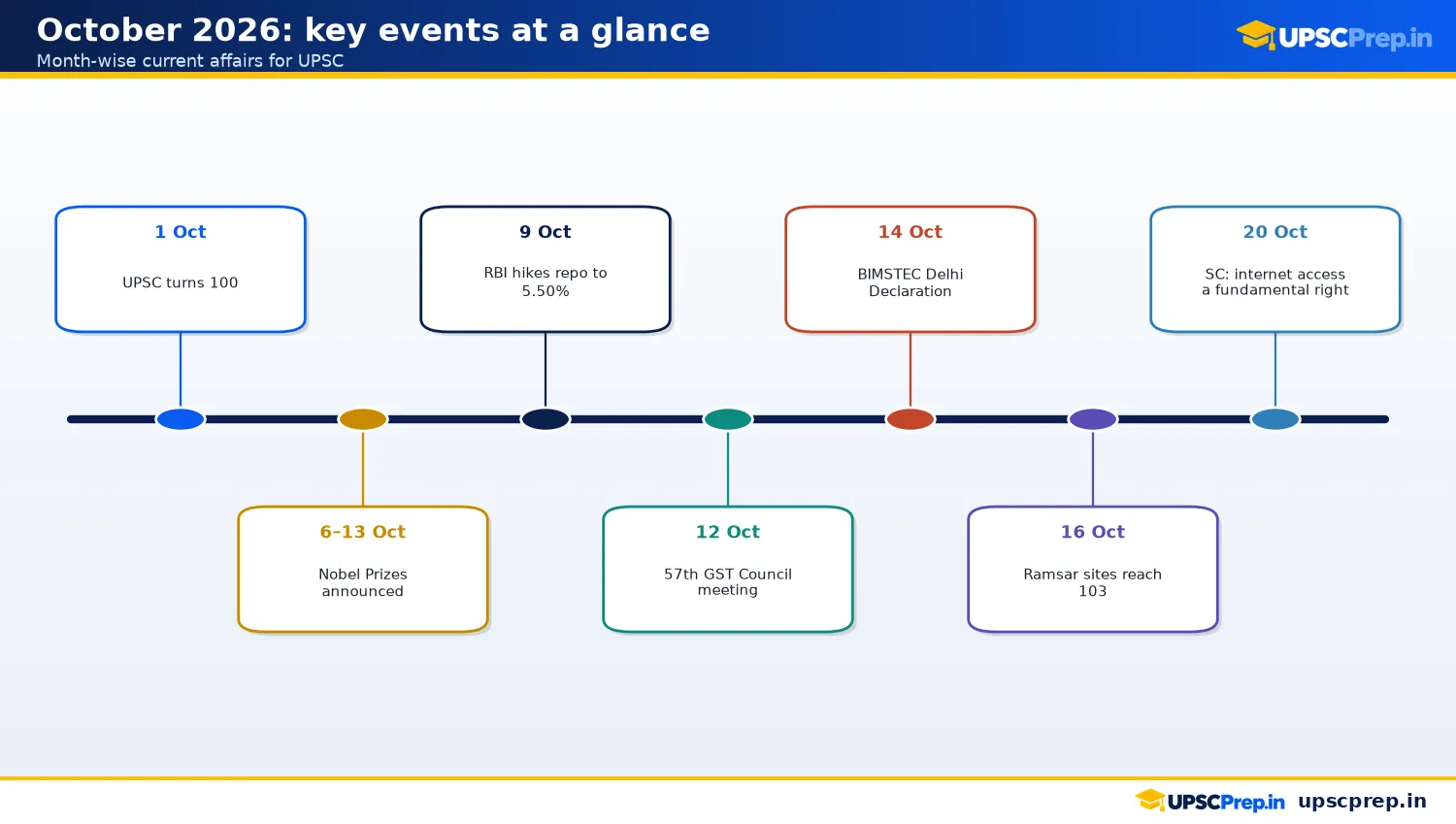
The biggest stories of October 2026 (covered up to 20 October), explained simply and grouped by GS paper. Read each item, then check the "Why it matters" line to link it to the syllabus.
In this compilation: 33 major items, grouped by GS theme · 10-question quiz at the end.
Timeline: key events of October 2026
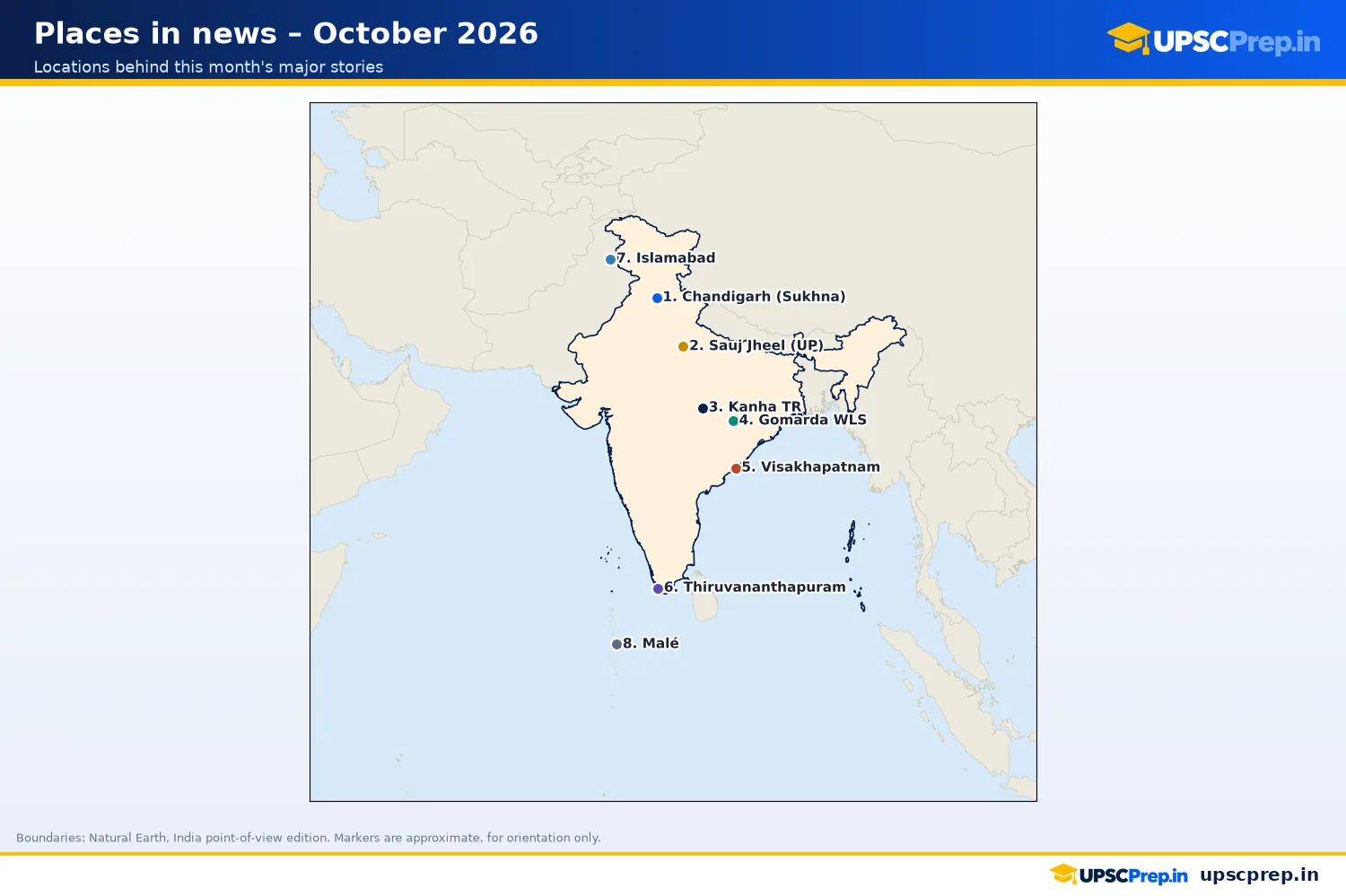
Places in news, October 2026
Polity & Governance
1. UPSC completes 100 years
- The Union Public Service Commission completed its centenary on 1 October 2026.
- It traces its roots to the Public Service Commission set up in 1926 under the Government of India Act, 1919.
- Today it is an independent constitutional body under Articles 315–323, recruiting for the All India and Central Services.
Why it matters for UPSC: Constitutional bodies (Articles 315–323), independence of recruiting agencies and merit-based civil services are standard Prelims and Mains themes.
Syllabus: GS2 – Constitutional bodies
2. Supreme Court: internet access is a fundamental right
- In Just Rights for Children Alliance v. S. Harish (2026), the Supreme Court declared internet access and use a fundamental right.
- The Court located it in Articles 21 (life and liberty) and 19(1)(a) (speech and expression), including for children.
- It has sought views from the Centre and NCPCR on a framework for children's social-media safety.
Why it matters for UPSC: Builds on Anuradha Bhasin (2020) and Faheema Shirin (Kerala HC, 2019); useful for Mains questions on digital rights and internet shutdowns.
Syllabus: GS2 – Fundamental Rights
3. Supreme Court on religious conversion and reservation
- The Court upheld a Madras High Court ruling that struck down a 2024 Tamil Nadu order letting people who converted from Hinduism to Islam claim the BC (Muslim) quota automatically.
- It held that reservation under Article 16(4) cannot be claimed only on the basis of pre-conversion status; backwardness must be shown.
- The case was Secretary to Government v. Sameer Ahamed N. (2026).
Why it matters for UPSC: Links Articles 15(4), 16(4), the Presidential Order on Scheduled Castes (1950) and the debate on Dalit Christians and Muslims.
Syllabus: GS2 – Polity, Reservation
4. Parliamentary Standing Committees reconstituted for 2026–27
- The Lok Sabha Speaker and Rajya Sabha Chairman reconstituted the Department-related Standing Committees (DRSCs).
- India has 24 DRSCs; each has 31 members (21 from Lok Sabha, 10 from Rajya Sabha) with a one-year term.
- They scrutinise ministries' demands for grants, Bills and policies; the system began in 1993.
Why it matters for UPSC: Committee system is a frequent Mains topic on parliamentary accountability and declining scrutiny of Bills.
Syllabus: GS2 – Parliament
5. Jantar Mantar denotified as a protest site
- Delhi Police withdrew Jantar Mantar's status as a designated protest site on an MHA committee's advice.
- Ramlila Ground, Burari Ground and the CBD Ground (East Delhi) were named as alternative venues.
- Jantar Mantar is an 18th-century observatory built in 1724 by Maharaja Sawai Jai Singh II.
Why it matters for UPSC: Right to protest under Article 19(1)(a) and (b) with reasonable restrictions (Mazdoor Kisan Shakti Sangathan case, 2018).
Syllabus: GS2 – Rights and public order
6. Cabinet approves Integrated Transport and Logistics Authority (ITLA)
- ITLA will be a special purpose vehicle for research, planning, project appraisal and monitoring across transport and logistics.
- It aims to bring roads, railways, ports, waterways and aviation planning onto one platform.
- It complements PM GatiShakti, which completed five years in October 2026.
Why it matters for UPSC: Integrated multimodal planning and logistics costs are core GS3 infrastructure topics.
Syllabus: GS3 – Infrastructure
International Relations
7. India attends SCO meeting in Pakistan
- A senior Indian diplomat travelled to Pakistan for the SCO Council of National Coordinators meeting.
- It was the first official Indian visit to Pakistan since Operation Sindoor.
- Pakistan holds the SCO presidency for 2026–27, taken over at the Bishkek summit.
Why it matters for UPSC: Shows how multilateral obligations can keep channels open even when bilateral ties are frozen.
Syllabus: GS2 – India and its neighbourhood
8. First BIMSTEC Home Ministers' meeting adopts Delhi Declaration
- Home Ministers of the seven BIMSTEC members met for the first time, in New Delhi.
- The Delhi Declaration denounced all terrorism, cross-border attacks included, and sought joint action against narcotics, cyber offences and trafficking.
- Members: Bangladesh, Bhutan, India, Myanmar, Nepal, Sri Lanka and Thailand.
Why it matters for UPSC: BIMSTEC is central to India's Act East and Neighbourhood First policies; a security pillar is new.
Syllabus: GS2 – Regional groupings
9. India rolls over ₹30 billion currency swap for the Maldives
- India agreed to extend the repayment of the Maldives' first ₹30 billion draw from the bilateral swap line.
- A swap lets central banks exchange currencies for a period, easing short-term foreign-exchange stress.
- The RBI offers such support under the SAARC Currency Swap Framework 2024–27.
Why it matters for UPSC: Economic diplomacy under Neighbourhood First; links to balance-of-payments support tools.
Syllabus: GS2 – India and its neighbourhood
10. US ends Operation Inherent Resolve in Iraq
- The US completed its troop withdrawal from Iraq, closing the 12-year Operation Inherent Resolve.
- The mission was launched in 2014 to defeat the Islamic State (IS).
- The withdrawal changes the security balance in West Asia, where India has energy and diaspora interests.
Why it matters for UPSC: West Asia's security shifts affect oil prices, the Indian diaspora and connectivity projects such as IMEC.
Syllabus: GS2 – International relations
11. WHO Pandemic Agreement: India's stand at the UN
- At a UN High-Level Meeting in New York (September 2026), India spoke on the political declaration on pandemic prevention, preparedness and response.
- Talks on the Pathogen Access and Benefit-Sharing (PABS) system under the WHO Pandemic Agreement remain unresolved.
- India stresses equitable access to vaccines, diagnostics and technology for developing countries.
Why it matters for UPSC: Global health governance and equity are recurring GS2 themes after COVID-19.
Syllabus: GS2 – International institutions
Economy
12. RBI raises repo rate to 5.50%
- The MPC raised the repo rate by 25 basis points to 5.50%, its first hike since February 2023.
- The stance shifted to "calibrated tightening" to tackle persistent inflation.
- SDF is now 5.25%; MSF and Bank Rate are 5.75%.
Why it matters for UPSC: Know the policy corridor (SDF–repo–MSF) and how rate changes transmit to inflation and growth.
Syllabus: GS3 – Monetary policy
13. 57th GST Council meeting
- The Council cleared process changes that make registration, refunds, input tax credit, exports and dispute handling easier.
- No changes were made to GST rates in this meeting.
- Most changes are planned to take effect from 1 April 2027.
Why it matters for UPSC: The GST Council (Article 279A) is a key example of cooperative federalism.
Syllabus: GS3 – Taxation
14. PM Dhan-Dhaanya Krishi Yojana completes one year
- The six-year scheme was launched on 11 October 2025.
- It targets 100 Aspirational Agricultural Districts with low productivity and low credit flow.
- It brings together many existing schemes for district-level farm planning.
Why it matters for UPSC: Convergence of schemes and district-based planning is a good Mains example for agricultural reform.
Syllabus: GS3 – Agriculture
15. Mission for Aatmanirbharta in Pulses: one year
- The mission was launched on 11 October 2025 with ₹11,440 crore for 2025–26 to 2030–31.
- Its goal is self-sufficiency in pulses by 2030–31 by raising output and cutting imports.
- It focuses on tur, urad and masoor, with assured procurement for farmers.
Why it matters for UPSC: Pulses are vital for protein security; India is the largest producer and also a large importer.
Syllabus: GS3 – Agriculture, food security
16. India–EU Green Shipping Corridor launched
- An industry coalition for the corridor was launched at Sagarmanthan 2026, the 3rd Great Oceans Dialogue.
- It aims to promote low-emission ship fuels such as green hydrogen, ammonia and methanol.
- The Ministry of Ports, Shipping and Waterways organised the dialogue.
Why it matters for UPSC: Links Maritime India Vision 2030, green hydrogen and decarbonising shipping.
Syllabus: GS3 – Infrastructure, climate
Environment & Ecology
17. Sukhna Wetland and Sauj Jheel become Ramsar sites
- India's Ramsar sites rose to 103 with these two additions.
- Sukhna Wetland lies in the Shivalik foothills in Chandigarh.
- Sauj Jheel is in Uttar Pradesh.
Why it matters for UPSC: Ramsar site counts and locations are regular Prelims questions.
Syllabus: GS3 – Conservation
18. Living Planet Report 2026
- WWF and the Zoological Society of London released the report, titled "The Science of Hope".
- Tracked wildlife populations shrank by 73% on average from 1970 to 2022.
- The report is published every two years using the Living Planet Index.
Why it matters for UPSC: A key global index for biodiversity loss questions.
Syllabus: GS3 – Biodiversity
19. Wild buffaloes return to Kanha Tiger Reserve
- Madhya Pradesh began reintroducing wild buffaloes after about 100 years of absence.
- The animals came from Kaziranga National Park, Assam, about 2,200 km away.
- They are being acclimatised in enclosures in the Supkhar range before release.
Why it matters for UPSC: Wild water buffalo is Endangered (IUCN) and in Schedule I; reintroduction is a conservation tool.
Syllabus: GS3 – Species reintroduction
20. Blackbuck translocation in Chhattisgarh
- 50 blackbucks will be moved from Barnawapara Wildlife Sanctuary to Gomarda Wildlife Sanctuary.
- The species had disappeared locally from Gomarda in the 1970s.
- Barnawapara's boundaries are formed by the Balamdehi and Jonk rivers, tributaries of the Mahanadi.
Why it matters for UPSC: Blackbuck is in Schedule I of the Wildlife (Protection) Act; site-based facts suit Prelims.
Syllabus: GS3 – Species conservation
Science & Technology
21. Nobel Prize in Medicine 2026: optogenetics
- Awarded to Karl Deisseroth (USA), Peter Hegemann and Georg Nagel (Germany).
- Honoured for discoveries on light-gated ion channels and optogenetics.
- Optogenetics lets scientists switch specific neurons on or off using light.
Why it matters for UPSC: Applications in neuroscience, Parkinson's and vision research.
Syllabus: GS3 – Biotechnology
22. Nobel Prize in Physics 2026: IceCube
- Awarded to Francis Halzen for the IceCube Neutrino Observatory at the South Pole.
- IceCube detected high-energy neutrinos from outside our galaxy.
- Neutrinos are nearly massless particles that pass through matter easily.
Why it matters for UPSC: Link with India's proposed India-based Neutrino Observatory (INO) in Tamil Nadu.
Syllabus: GS3 – Space science
23. Nobel Prize in Chemistry 2026
- Awarded to Henri B. Kagan (France) and Kenso Soai (Japan).
- The award recognises work on autocatalysis and non-linear effects in making chiral organic molecules.
- Their work explains how small differences in molecular "handedness" get amplified.
Why it matters for UPSC: Chirality matters in medicines, where one mirror-image form can be useful and the other harmful.
Syllabus: GS3 – Science
24. India's first 5.56 km free-space quantum key distribution link
- The link connected BISAG-N and IIT Gandhinagar in Gujarat.
- It was demonstrated with the Indian deep-tech startup QNu Labs.
- QKD uses quantum states of light to share keys that reveal any eavesdropping.
Why it matters for UPSC: Supports the National Quantum Mission (2023–31) and secure communication.
Syllabus: GS3 – Emerging tech
25. CERVAVAC gets WHO prequalification
- Serum Institute of India's quadrivalent HPV vaccine was WHO-prequalified from 25 September 2026.
- It is India's first indigenous HPV vaccine to get this status, letting UN agencies buy it.
- It was developed with support from DBT and BIRAC.
Why it matters for UPSC: Cervical cancer prevention and vaccine diplomacy; HPV vaccination of girls aged 9–14.
Syllabus: GS2/GS3 – Health
26. TRISHNA satellite nears launch
- TRISHNA is a joint ISRO–CNES (France) Earth-observation mission.
- It will map land and water surface temperature at high resolution.
- ISRO expects launch within 12–16 months.
Why it matters for UPSC: Useful for water stress, irrigation and urban heat studies; India–France space ties.
Syllabus: GS3 – Space
27. Towards a TB-free India
- The WHO Global TB Report 2025 says India's TB incidence fell 21% between 2015 and 2024, against 12% globally.
- Treatment coverage reached 92%, but India still has about 25% of the world's TB cases.
- JOSH (Joint Squad for Health) teams were launched to boost community participation.
Why it matters for UPSC: Combine with Ni-kshay Poshan Yojana and the SDG target of ending TB.
Syllabus: GS2 – Health
Security & Defence
28. Air Marshal Ashutosh Dixit named 29th Chief of the Air Staff
- He will succeed Air Chief Marshal Amar Preet Singh, who retires on 31 October 2026.
- He was commissioned into the fighter stream in 1986 and is an experimental test pilot.
- He has flown Mirage-2000, MiG variants, Jaguar and Tejas.
Why it matters for UPSC: Persons in news; appointments to service chiefs are a Prelims staple.
Syllabus: GS3 – Defence
29. Surya, the Navy's first indigenous fleet support ship
- Surya (FSS-1) was launched at Hindustan Shipyard Limited, Visakhapatnam.
- Fleet support ships refuel and resupply warships at sea.
- The keel of FSS-5 was also laid.
Why it matters for UPSC: Shows growth in indigenous shipbuilding and blue-water naval reach.
Syllabus: GS3 – Defence
30. DRDO tests High Altitude Platform System
- DRDO flight-tested an indigenous HAPS for long-endurance surveillance in the stratosphere.
- HAPS operate at roughly 20–50 km altitude, per the ITU definition.
- They can act like low-cost "pseudo-satellites".
Why it matters for UPSC: A bridge between drones and satellites for border surveillance and communication.
Syllabus: GS3 – Defence technology
31. Exercise AUSTRAHIND 2026
- The 5th edition of the India–Australia army exercise began at the Foreign Training Node, Thiruvananthapuram.
- It improves interoperability between the two armies.
- The exercise alternates between India and Australia.
Why it matters for UPSC: Exercise–country pairs are frequently asked in Prelims.
Syllabus: GS3 – Defence exercises
Persons & Awards
32. Navi Pillay wins Nobel Peace Prize 2026
- The South African jurist of Indian (Tamil) descent was awarded the 2026 Nobel Peace Prize.
- She formerly served as a judge at the International Criminal Court and as UN High Commissioner for Human Rights.
- The US imposed sanctions on the ICC hours after the announcement.
Why it matters for UPSC: Links human rights institutions and the ICC's role and limits.
Syllabus: GS2 – International institutions
33. Anne Carson wins Nobel Prize in Literature 2026
- The Canadian poet, essayist and translator won for bold, inventive writing.
- Her work blends ancient Greek and Roman themes with modern forms.
- She was born in Toronto in 1950.
Why it matters for UPSC: Nobel laureates are standard Prelims facts.
Syllabus: GS1 – Persons in news
Monthly current affairs quiz
Test yourself on this month: Take the October 2026 quiz (10 questions)
Summaries are written in our own words. Always confirm figures with the official release before quoting them in an exam answer.