Monthly Current Affairs: September 2026 – major news for UPSC
Monthly Compilation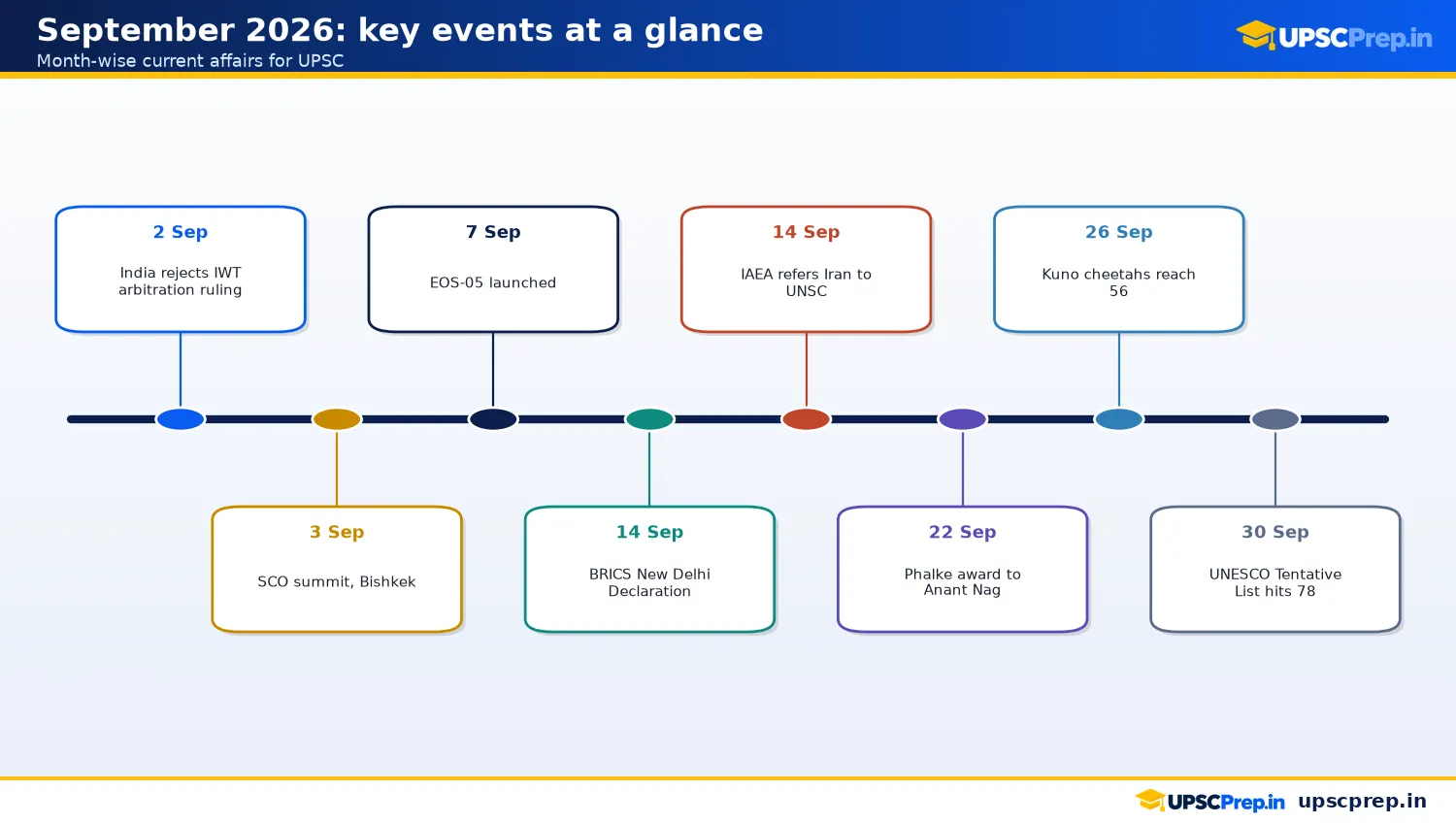
The major current affairs of September 2026, grouped by GS paper. India's BRICS summit in New Delhi, the Indus Waters arbitration row and a string of Supreme Court rulings on liberty dominated the month.
In this compilation: 33 major items, grouped by GS theme · 10-question quiz at the end.
Timeline: key events of September 2026
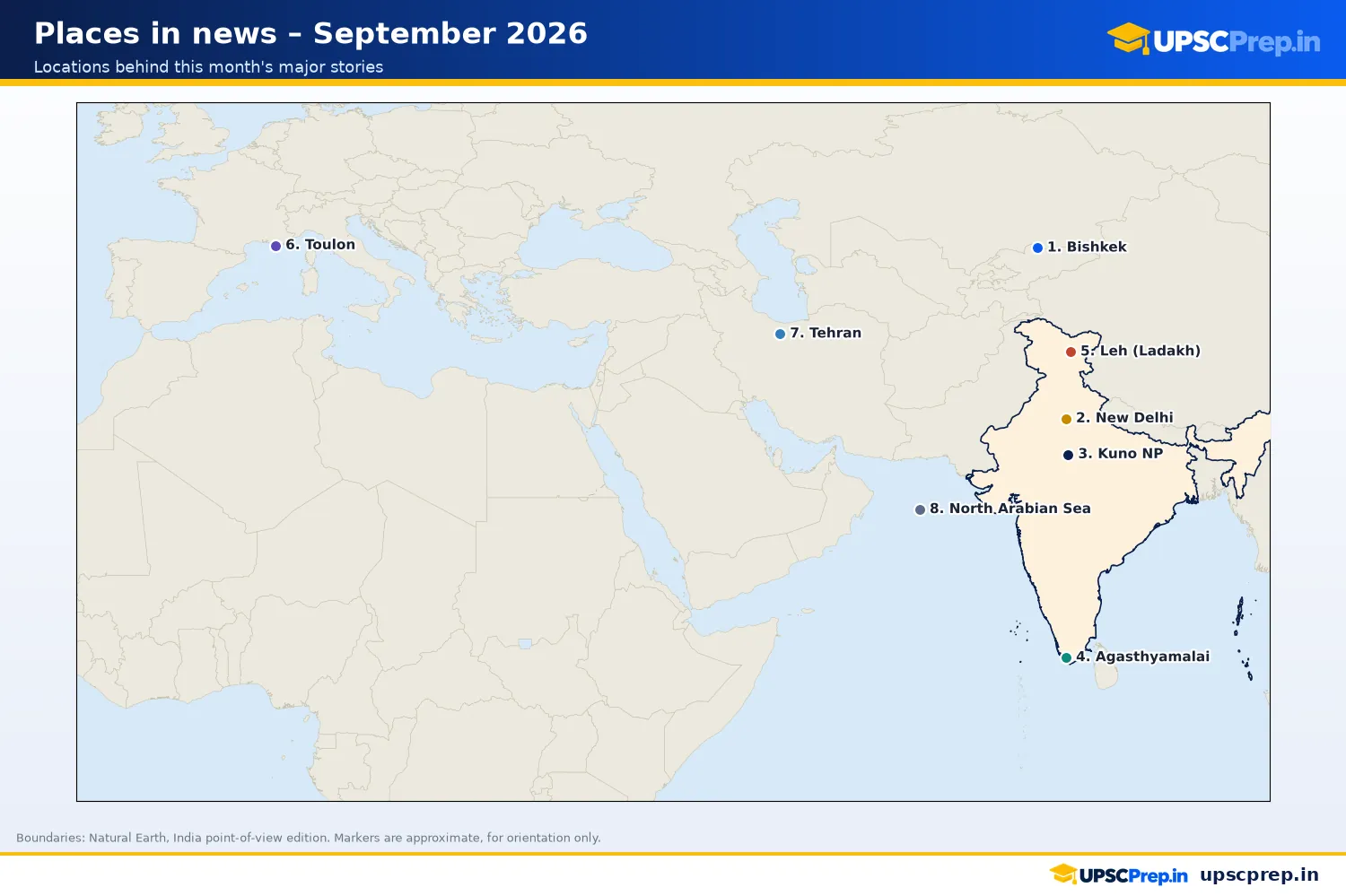
Places in news, September 2026
Polity & Governance
1. MHA proposes Article 371(K) for Ladakh
- The Home Ministry proposed a new "Chapter K" under Article 371 (Part XXI) for Ladakh.
- It would give the Union Territory a tailor-made governance model with a directly elected legislative body.
- The move responds to long-running demands for safeguards on land, jobs and culture in Ladakh.
Why it matters for UPSC: Compare Article 371 special provisions with the Sixth Schedule demand; a likely Mains question on federalism.
Syllabus: GS2 – Special provisions, UTs
2. SC: arrest is illegal if grounds are not properly communicated
- In Jaskaran Jeet Singh Deol v. State of Punjab (2026), the Court reinforced Article 22 safeguards.
- Failure to properly tell an arrested person the grounds of arrest can make the arrest and detention illegal.
- The Court also laid down safeguards against repeated re-arrest.
Why it matters for UPSC: Builds on Pankaj Bansal (2023) and Prabir Purkayastha (2024); core to Article 21–22 questions.
Syllabus: GS2 – Fundamental Rights
3. Supreme Court uses Article 142 to quash protest FIRs
- The Court used Article 142 to quash FIRs filed in several states against participants in the nationwide examination protests.
- The order made the deal reached by the Centre and the protesters legally binding.
- Article 142 lets the Court pass any order needed to do "complete justice".
Why it matters for UPSC: Article 142 and judicial overreach versus complete justice is a recurring Mains debate.
Syllabus: GS2 – Judiciary
4. The unused "distinguished jurist" route to the Supreme Court
- Article 124(3)(c) allows a "distinguished jurist", in the President's opinion, to be appointed a Supreme Court judge.
- In over 76 years the provision has never been used to appoint an academic.
- A sitting judge raised the point at NLU Delhi's convocation.
Why it matters for UPSC: Prelims-friendly fact on judge eligibility (5 years as HC judge, 10 years as HC advocate, or distinguished jurist).
Syllabus: GS2 – Judiciary
5. ECI freezes a party's name and symbol
- The Election Commission froze the name and reserved symbol of the All India Trinamool Congress amid rival faction claims before West Bengal bypolls.
- When a dispute cannot be settled before a poll, the ECI can freeze the symbol and give interim names and symbols.
- Its power comes from the Election Symbols (Reservation and Allotment) Order, 1968, under Article 324.
Why it matters for UPSC: Useful for questions on intra-party disputes and the Symbols Order (Paragraph 15).
Syllabus: GS2 – Elections
6. Allahabad HC: conversion does not automatically end ST status
- The Court held that religious conversion does not by itself end Scheduled Tribe status.
- Whether status continues is a question of fact: the person must show continuing ties to tribal customs and community life.
- It relied on the Supreme Court's reasoning in earlier ST status cases.
Why it matters for UPSC: Contrast with SC status, which the 1950 Presidential Order limits to Hindus, Sikhs and Buddhists.
Syllabus: GS2 – Social justice
International Relations
7. India hosts the 18th BRICS Summit
- India hosted its fourth BRICS chairship in New Delhi with the theme "Building for Resilience, Innovation, Cooperation and Sustainability".
- Leaders adopted the New Delhi Declaration on multilateralism, conflict prevention and fairer global governance.
- India proposed 10 global-governance reform ideas to be shaped into a BRICS Reform Roadmap by 2027.
Why it matters for UPSC: BRICS expansion, de-dollarisation debates and UN reform are high-probability Mains themes.
Syllabus: GS2 – Groupings
8. 26th SCO Summit in Bishkek
- Kyrgyzstan hosted the 26th Council of Heads of State and the first "SCO Plus" meeting.
- The summit marked SCO's 25th anniversary.
- Pakistan took over the SCO presidency for 2026–27.
Why it matters for UPSC: SCO members, RATS and India's stand on BRI are Prelims and Mains favourites.
Syllabus: GS2 – Groupings
9. India rejects Hague court ruling on the Indus Waters Treaty
- The Court of Arbitration said the treaty remains in force despite India placing it "in abeyance" in April 2025.
- India called the court illegally constituted with no jurisdiction over its sovereign decisions.
- The 1960 treaty, brokered by the World Bank, gives the eastern rivers to India and the western rivers mainly to Pakistan.
Why it matters for UPSC: Water as a strategic tool; dispute mechanisms (Neutral Expert vs Court of Arbitration) under the IWT.
Syllabus: GS2 – India–Pakistan
10. India rejects the Pakistan–China Boundary Joint Commission
- Pakistan and China held the commission's first meeting in Islamabad in September 2026.
- India said the body has no legal basis because there is no lawful Pakistan–China boundary in the area.
- The area concerned includes the Shaksgam Valley, ceded by Pakistan to China in 1963.
Why it matters for UPSC: Ties into CPEC and India's claim over all of Jammu and Kashmir and Ladakh.
Syllabus: GS2 – India–China–Pakistan
11. IAEA refers Iran to the UN Security Council
- For the first time in two decades, the IAEA's Board sent Iran's case to the UNSC.
- It cited Iran's failure to meet safeguards obligations and to cooperate with inspectors.
- The US, UK, France and Germany sponsored the resolution.
Why it matters for UPSC: Affects oil prices, Chabahar port and India's West Asia balancing.
Syllabus: GS2 – Nuclear non-proliferation
12. India–Pakistan naval collision in the North Arabian Sea
- Pakistani patrol vessel PNS Hunain collided with Indian destroyer INS Kolkata.
- INS Kolkata is the lead ship of the Project 15A destroyers built by Mazagon Dock.
- The incident led to a diplomatic row between the two countries.
Why it matters for UPSC: Rules of the road at sea (COLREGs) and the need for maritime confidence-building measures.
Syllabus: GS3 – Maritime security
Economy
13. National Accounts Statistics 2026 on a new base year
- MoSPI released National Accounts Statistics 2026 with 2022–23 as the new base year (replacing 2011–12).
- The revision brings in new data sources and methods for GDP and national income.
- A newer base better reflects the digital and services economy.
Why it matters for UPSC: Base-year revision is a classic Prelims and Mains topic on data credibility.
Syllabus: GS3 – Growth and statistics
14. NPCI brings MDR on large merchant UPI payments
- A 0.4% merchant discount rate will apply to eligible person-to-merchant UPI payments above ₹2,000.
- It takes effect from 15 October 2026.
- MDR is the charge a shopkeeper pays banks and payment companies each time a digital payment is processed.
Why it matters for UPSC: Balances the zero-MDR policy with the need to fund the UPI ecosystem.
Syllabus: GS3 – Digital payments
15. ECLGS 5.0 for businesses facing external shocks
- The Emergency Credit Line Guarantee Scheme 5.0 was approved in May 2026.
- It gives government-backed guarantees so MSMEs, other firms and scheduled airlines can get credit.
- The first ECLGS was launched in 2020 during COVID-19.
Why it matters for UPSC: Credit guarantee schemes as a counter-cyclical tool for MSMEs.
Syllabus: GS3 – MSMEs, credit
16. RBI uses forex swaps and VRRR to manage rupee and liquidity
- The RBI used a forex swap facility to steady the weakening rupee.
- It used Variable Rate Reverse Repo (VRRR) auctions to absorb surplus liquidity.
- Both are tools of liquidity management alongside the repo and SDF.
Why it matters for UPSC: Know the instruments of liquidity management and how they affect the rupee.
Syllabus: GS3 – Monetary policy
17. India's first blue bond
- Sagarmala Finance Corporation Limited, India's first maritime-sector NBFC, will issue the bond.
- The maiden issue aims to raise ₹600 crore for sustainable maritime and ocean projects.
- Blue bonds are debt instruments for ocean-related, environment-friendly projects.
Why it matters for UPSC: Links blue economy, Sagarmala and green finance.
Syllabus: GS3 – Blue economy finance
18. Scheme for rare earth permanent magnets
- The scheme supports domestic manufacturing of sintered rare earth permanent magnets.
- These magnets are vital for electric vehicles, wind turbines and defence systems.
- India aims to cut dependence on China, which dominates the supply chain.
Why it matters for UPSC: Critical minerals and supply-chain security; National Critical Mineral Mission.
Syllabus: GS3 – Critical minerals
Environment & Ecology
19. UNEP's "Limiting Overshoot" report
- UNEP says a temporary breach of the 1.5°C Paris goal is now virtually inevitable.
- It proposes an "overshoot, peak and decline" framework to limit peak warming and bring temperatures back down.
- This needs deep emission cuts plus carbon removal.
Why it matters for UPSC: Useful for Mains on climate targets and carbon dioxide removal.
Syllabus: GS3 – Climate change
20. UK recognises India's Carbon Credit Trading Scheme under its CBAM
- Britain now recognises India's CCTS as an eligible carbon price for its Carbon Border Adjustment Mechanism.
- Indian exporters can get relief for carbon prices already paid at home.
- It followed technical talks under UK–India energy cooperation.
Why it matters for UPSC: CBAM is a key trade–climate issue for Indian steel and aluminium exports.
Syllabus: GS3 – Climate finance, trade
21. Four cheetah cubs born at Kuno
- India-born female KGP12 gave birth to four cubs in Kuno National Park, Madhya Pradesh.
- India's cheetah population rose to 56.
- Project Cheetah, launched in September 2022, completed four years.
Why it matters for UPSC: Project Cheetah is a frequent Prelims topic; Gandhi Sagar is the second site.
Syllabus: GS3 – Conservation
22. 3,261 flowering plant species in Agasthyamalai
- JNTBGRI, Thiruvananthapuram compiled a new checklist for the Agasthyamalai Biosphere Reserve.
- It records 3,261 species, 26 subspecies and 28 varieties from 190 families.
- The reserve spans Kerala and Tamil Nadu in the southern Western Ghats and is in UNESCO's MAB network.
Why it matters for UPSC: Biosphere reserves and the Western Ghats hotspot are regular Prelims areas.
Syllabus: GS3 – Biodiversity
23. World Ozone Day and the Montreal Protocol
- World Ozone Day is observed on 16 September, the date the Montreal Protocol was signed in 1987.
- The Kigali Amendment (2016) adds a phase-down of HFCs.
- India must freeze HFC use by 2028 and cut it from 2032.
Why it matters for UPSC: Montreal is often called the most successful environmental treaty.
Syllabus: GS3 – Environment
Science & Technology
24. EOS-05, India's first geosynchronous imaging satellite
- ISRO launched EOS-05 on the GSLV-F17 from Sriharikota.
- It is India's first dedicated Earth-imaging satellite operating from geosynchronous orbit.
- It allows near-continuous watch over the subcontinent for disasters and security.
Why it matters for UPSC: Orbits (LEO, GEO, GSO) are frequently tested in Prelims.
Syllabus: GS3 – Space
25. Aditya-L1 spots warning signs before solar flares
- Scientists found small, short-lived brightenings in the Sun's atmosphere hours before big flares.
- These appear near the spot where the flare later erupts.
- Aditya-L1 orbits the Sun–Earth L1 point, about 1.5 million km from Earth.
Why it matters for UPSC: Space weather forecasting protects satellites and power grids.
Syllabus: GS3 – Space science
26. C-DOT unveils 14 quantum products
- C-DOT showcased 14 indigenous products for secure communication on its 43rd Foundation Day.
- They cover Quantum Key Distribution (QKD) and Post-Quantum Cryptography (PQC).
- C-DOT works under the Department of Telecommunications.
Why it matters for UPSC: National Quantum Mission and cybersecurity of critical networks.
Syllabus: GS3 – Emerging technology
Security & Defence
27. IAF tests Khagantak-243 glide bomb
- The IAF test-dropped the indigenous Khagantak-243 long-range glide bomb.
- It was built by Nagpur start-up JSR Dynamics with Bharat Electronics Limited.
- Glide bombs let aircraft strike targets from a safe stand-off distance.
Why it matters for UPSC: Example of start-ups in defence manufacturing.
Syllabus: GS3 – Defence technology
28. Exercise VARUNA, 24th edition
- The India–France naval exercise began at Toulon, France, with INS Trishul.
- VARUNA began in 2001.
- It strengthens maritime cooperation in the Indian Ocean and beyond.
Why it matters for UPSC: Exercise–country pairs are Prelims staples.
Syllabus: GS3 – Defence exercises
Persons, Awards & Culture
29. Ramon Magsaysay Awards 2026
- Awardees: Tommy Koh (Singapore), Runa Khan (Bangladesh) and Bo Kyi (Myanmar).
- The award was set up in 1958 and is often called Asia's Nobel Prize.
- It honours the former Philippine President Ramon Magsaysay.
Why it matters for UPSC: Awards and their founders are a Prelims staple.
Syllabus: GS1 – Persons in news
30. Anant Nag to get the Dadasaheb Phalke Award
- The veteran Kannada actor was chosen for the Dadasaheb Phalke Award 2024.
- He is the second Kannada actor to receive it, after Dr. Rajkumar (1995).
- It was presented at the 72nd National Film Awards on 22 September 2026 in Kevadia, Gujarat.
Why it matters for UPSC: India's highest film honour; who gave it and to whom is a frequent question.
Syllabus: GS1 – Culture
31. Tulu made an additional official language in Karnataka
- Karnataka gave Tulu the status of second additional administrative language.
- It applies to the coastal districts of Dakshina Kannada and Udupi.
- ₹82 lakh a year is set aside for translation and training.
Why it matters for UPSC: Linked to the demand for Tulu's inclusion in the Eighth Schedule.
Syllabus: GS1/GS2 – Language
32. Five new entries on India's UNESCO Tentative List
- India added five properties and serial proposals, taking its Tentative List to 78.
- They include the Bagh Cave paintings in Madhya Pradesh.
- A Tentative List entry is the first step towards World Heritage nomination.
Why it matters for UPSC: Heritage sites and the UNESCO process feature often in Prelims.
Syllabus: GS1 – Heritage
33. Jharkhand's Mandar gets a GI tag
- The Geographical Indications Registry, Chennai granted the tag to the Mandar.
- It is a tribal percussion instrument used in folk performances and festivals.
- GI tags are given under the GI of Goods Act, 1999.
Why it matters for UPSC: GI tags state-wise are asked almost every year.
Syllabus: GS1 – Culture
Monthly current affairs quiz
Test yourself on this month: Take the September 2026 quiz (10 questions)
Summaries are written in our own words. Always confirm figures with the official release before quoting them in an exam answer.