Conflict of interest
Also: conflicts of interest, COI
Background and evolution
Every official has a private life: family, property, investments, friendships, political views and career plans. A conflict of interest is not wrongdoing in itself; it is a situation that creates a risk that private interests will shape public decisions. The concept developed in modern public administration and law as states moved from personal rule to impersonal, rule-bound bureaucracy, where an official's authority is held in trust for the public.
In India the idea is expressed in service conduct rules, judicial ethics, company law and anti-corruption laws. Internationally, the Nolan Committee (1995) in the United Kingdom set out the "Seven Principles of Public Life", and the OECD has issued guidelines on managing conflicts of interest. The Second Administrative Reforms Commission, in its report on "Ethics in Governance" (2007), recommended a code of ethics and clearer rules for disclosure.
Key features and provisions
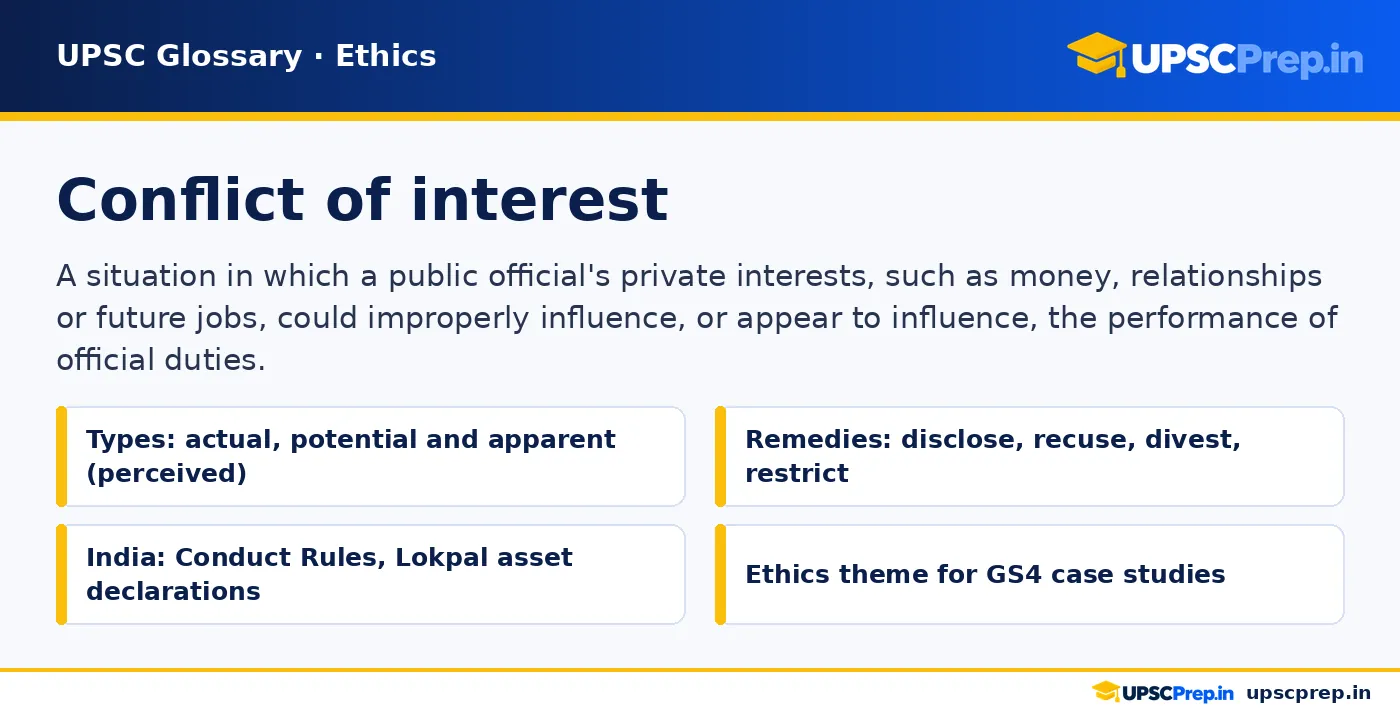
- Actual conflict: a direct clash exists now, for example an officer deciding a contract bid from a company owned by a relative.
- Potential conflict: a clash could arise in the future, for example holding shares in a sector that one may later regulate.
- Apparent or perceived conflict: a reasonable observer might believe there is a clash even if there is none; this still damages public trust.
- Pecuniary and non-pecuniary: interests may be financial or based on relationships, loyalties or ideology.
- Management tools: declaration of assets and interests, recusal from specific decisions, divestment of holdings, limits on gifts and hospitality, cooling-off periods before joining private firms, and independent oversight.
- Indian frameworks: the Central Civil Services (Conduct) Rules 1964 and All India Services (Conduct) Rules 1968 regulate gifts, investments and private employment; the Lokpal and Lokayuktas Act 2013 requires asset declarations; company law requires directors to disclose interests; and the "office of profit" provisions in Articles 102 and 191 protect legislators' independence.
You've read your 3 free glossary pages this month
Create a free account to read 5 full pages a month, or upgrade for unlimited access. The definition above, the A–Z index and the pop-up definitions in lessons stay free.
Last reviewed: 23 October 2026 · Original UPSCPrep.in content.