NIA Act, 2008
Also: National Investigation Agency Act, 2008, National Investigation Agency
Background and evolution
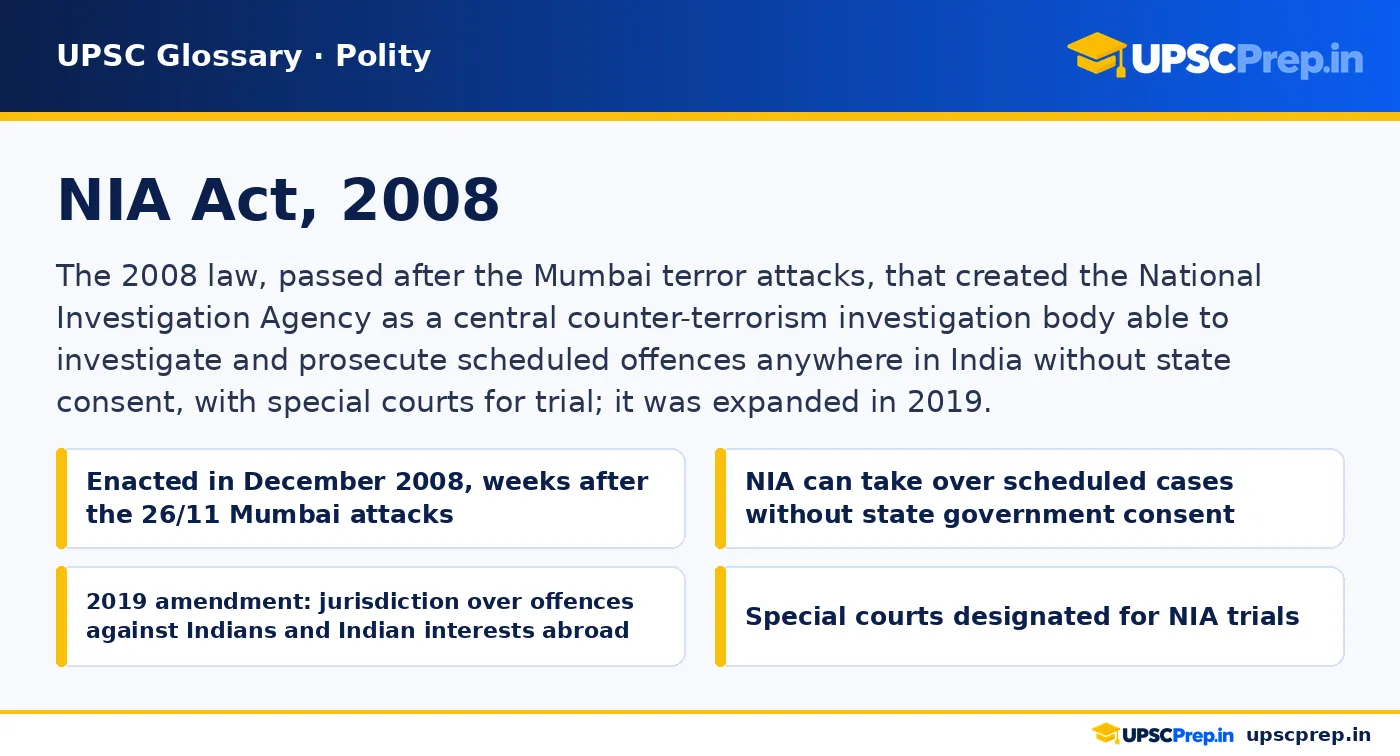
Before 2008, terrorism cases were investigated by state police, with the Central Bureau of Investigation able to act only with state consent under the Delhi Special Police Establishment Act. Inter-state and international dimensions of terrorism, and lack of coordination, were seen as major weaknesses. The Mumbai attacks of 26 November 2008, in which ten terrorists killed 166 people, created urgency. Parliament passed the National Investigation Agency Act and amendments to the Unlawful Activities (Prevention) Act in December 2008.
The Second ARC had earlier recommended a federal agency to investigate terrorism and organised crime. Because "police" and "public order" are state subjects, the Act drew on Union powers over defence, foreign affairs and Union agencies (Entries 1, 8 and 10 of the Union List), and on its power to legislate for criminal law in the Concurrent List.
Key features and provisions
- Scheduled offences: offences under laws listed in the Schedule, such as the UAPA, Atomic Energy Act, Anti-Hijacking Act, SAARC Convention (Suppression of Terrorism) Act, Weapons of Mass Destruction Act, and, after 2019, human trafficking, counterfeit currency, manufacture or sale of prohibited arms, cyber-terrorism and offences under the Explosive Substances Act.
- Suo motu power (Section 6): the Central Government can direct the NIA to investigate a scheduled offence if it is satisfied of its gravity, after a report from the state or on its own.
- No state consent: unlike the CBI, the NIA does not need state consent.
- State cooperation: states must render assistance; they can continue investigating until the NIA takes over.
- Special courts: the Central Government designates Sessions Courts as Special Courts for NIA cases, with day-to-day trials.
- Extraterritorial jurisdiction (2019): NIA can investigate scheduled offences committed outside India against Indian citizens or affecting Indian interests.
- Officers: NIA officers have the powers of police officers throughout India.
You've read your 3 free glossary pages this month
Create a free account to read 5 full pages a month, or upgrade for unlimited access. The definition above, the A–Z index and the pop-up definitions in lessons stay free.
Last reviewed: 23 October 2026 · Original UPSCPrep.in content.