Rajya Sabha
Also: Council of States, upper house
Background and evolution
A second chamber was debated in the Constituent Assembly. Critics saw it as a brake on the popular will; supporters argued that a federation needs a house where states are represented as units and where experienced people can review legislation calmly. The Assembly kept the upper house, but made it weaker than the Lok Sabha in money matters and in control of the executive.
The Rajya Sabha first met in 1952. Unlike the American Senate, where every state has equal seats, India allocates seats roughly by population, listed in the Fourth Schedule. This makes the Rajya Sabha a "federal" chamber in a limited sense: it represents the states' legislatures rather than giving them equal voice.
Key features and provisions
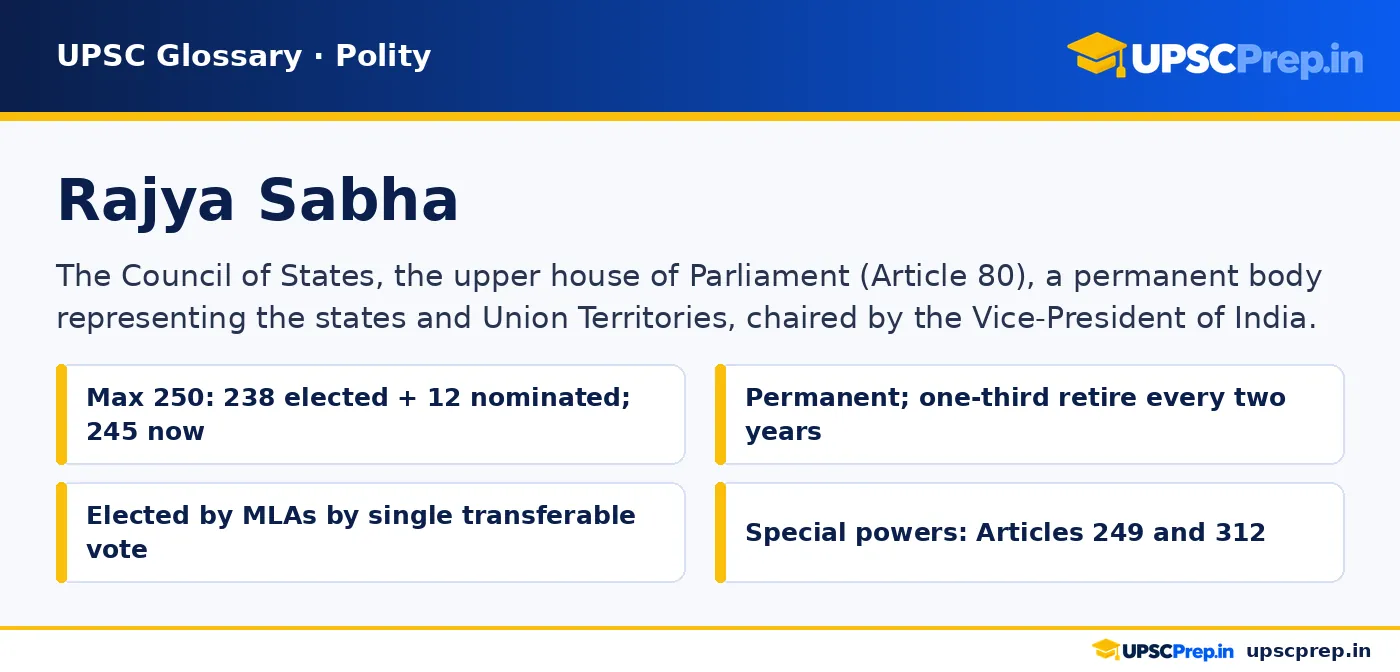
- Composition: up to 250 members under Article 80: 238 representatives of states and Union Territories, and 12 nominated by the President for knowledge or practical experience in literature, science, art and social service. The present strength is 245.
- Election: members from each state are elected by the elected members of its Legislative Assembly using proportional representation by single transferable vote; since 2003, voting in these elections is by open ballot to deter cross-voting.
- Permanence: the House is never dissolved; members serve six years, and one-third retire every second year.
- Qualifications: a citizen at least 30 years old; the requirement to be a voter of the state one represents was removed in 2003, and the Supreme Court upheld the change in Kuldip Nayar (2006).
- Presiding officer: the Vice-President is the ex officio Chairman; a Deputy Chairman is elected by members.
- Special powers: under Article 249 it can, by a two-thirds resolution, authorise Parliament to make laws on a State List subject in the national interest; under Article 312 it can authorise new All-India Services. It also approves emergency proclamations if the Lok Sabha has been dissolved.
- Limits: on Money Bills it can only recommend within 14 days, and the Council of Ministers is not responsible to it.
You've read your 3 free glossary pages this month
Create a free account to read 5 full pages a month, or upgrade for unlimited access. The definition above, the A–Z index and the pop-up definitions in lessons stay free.
Last reviewed: 23 October 2026 · Original UPSCPrep.in content.