Environment Protection Act 1986
Also: EPA 1986, Environment (Protection) Act
Background and evolution
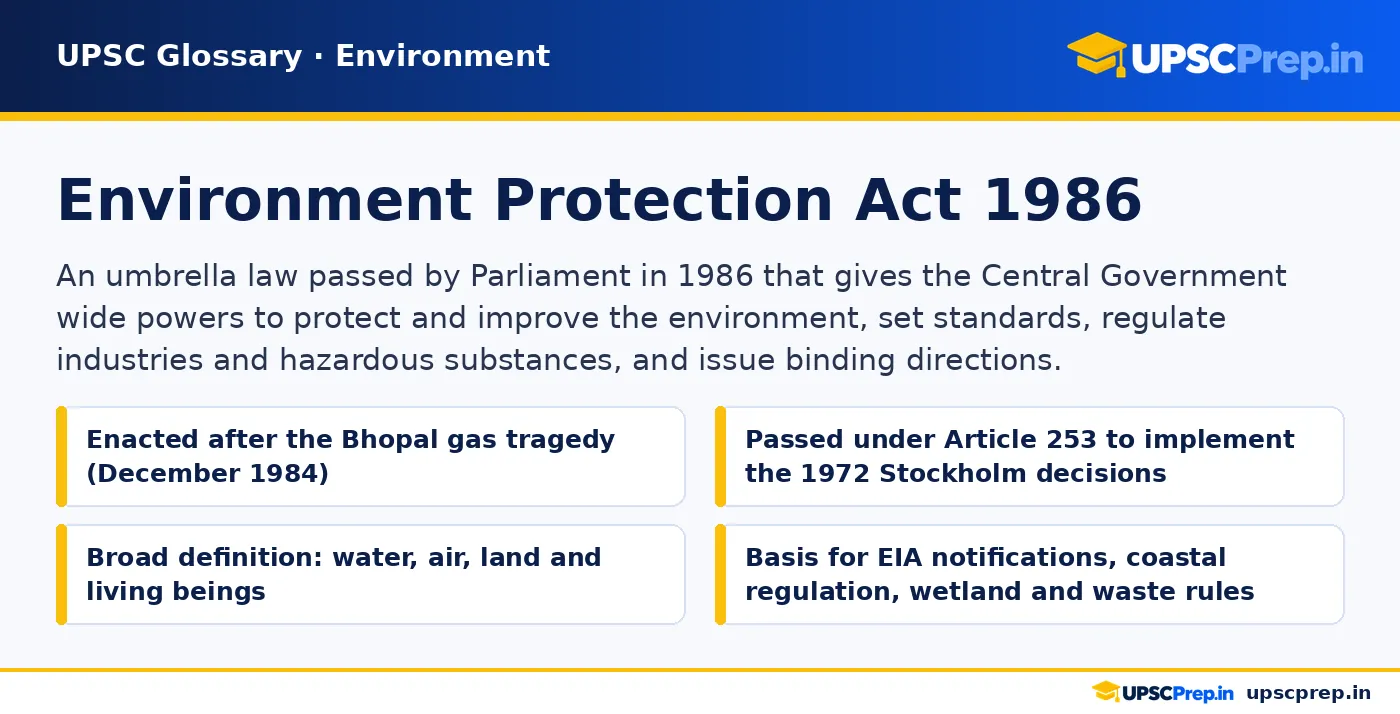
India already had laws on water (1974) and air (1981) pollution when, on the night of 2–3 December 1984, methyl isocyanate gas leaked from the Union Carbide pesticide plant at Bhopal and killed thousands of people. The disaster exposed gaps in the regulation of hazardous industries: there was no single authority with clear powers to set standards across all media, inspect plants or act quickly. Parliament responded with the Environment (Protection) Act, which came into force in November 1986.
The constitutional basis is Article 253, which allows Parliament to make laws to implement international agreements and decisions. The preamble of the Act refers to the decisions taken at the United Nations Conference on the Human Environment held at Stockholm in June 1972, in which India participated. The 42nd Amendment (1976) had already added Article 48A, a Directive Principle on protecting the environment, and Article 51A(g), a Fundamental Duty to protect nature.
Key features and provisions
- Wide definition: environment includes water, air and land and the interrelationship among them and human beings, other living creatures, plants, micro-organisms and property.
- Section 3: the Centre may take all measures it considers necessary, including setting standards for emissions and discharges, restricting industries in certain areas, and laying down safeguards for hazardous substances.
- Section 3(3): allows the Centre to constitute authorities; several bodies, such as the Central Ground Water Authority, were set up under this power.
- Section 5: power to issue written directions to any person, officer or authority, including closure, prohibition or regulation of an industry and stopping electricity or water supply.
- Section 6: rule-making power, the source of a large body of rules on hazardous waste, plastics, e-waste, biomedical waste, wetlands and more.
- Penalties: imprisonment and fines for violations; recent amendments through the Jan Vishwas Act moved many offences towards monetary penalties.
- Citizen complaints: Section 19 lets a person give notice and then complain to a court about an offence.
You've read your 3 free glossary pages this month
Create a free account to read 5 full pages a month, or upgrade for unlimited access. The definition above, the A–Z index and the pop-up definitions in lessons stay free.
Last reviewed: 23 October 2026 · Original UPSCPrep.in content.