Indo-Pacific
Also: Indo-Pacific region, Free and Open Indo-Pacific, FOIP
Background and evolution
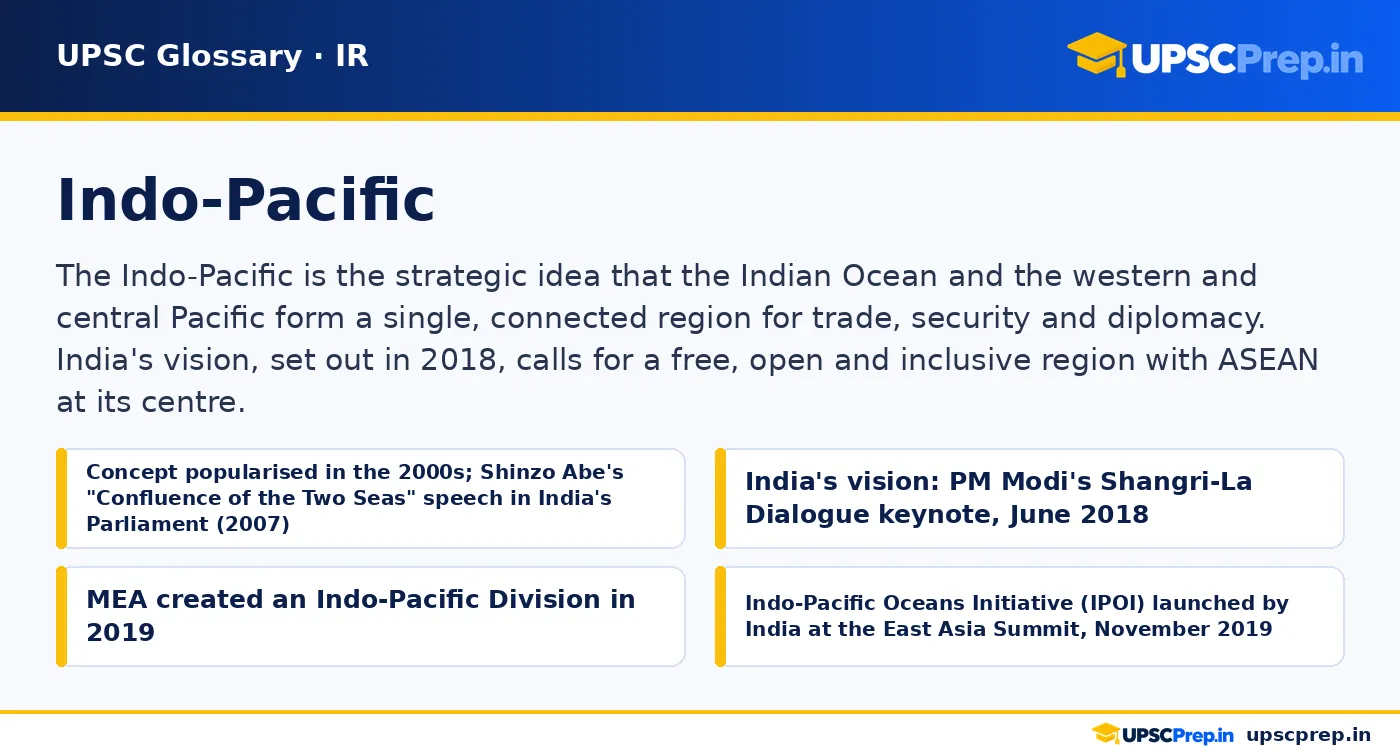
For most of the Cold War, strategists spoke of the "Asia-Pacific," a frame that centred on East Asia and the Pacific Rim and largely left India out. The rise of India's economy, the growth of trade crossing the Indian Ocean, and China's expanding naval presence led analysts to argue that the two oceans should be seen together. Japan's Prime Minister Shinzo Abe gave the idea political weight in his 2007 address to India's Parliament, describing the "dynamic coupling" of the two seas.
Over the next decade, Japan, the United States, Australia, India, France, the European Union, Germany, the United Kingdom and others published Indo-Pacific strategies or outlooks. Each defines the region slightly differently. The US definition has at times ended at the west coast of India, while India's runs from the shores of Africa to the Americas, reflecting its interests in the western Indian Ocean and the Gulf.
India set out its approach at the Shangri-La Dialogue in Singapore in 2018. The key words were free, open and inclusive; ASEAN centrality; a rules-based order applied equally to all; freedom of navigation and overflight; peaceful settlement of disputes; and connectivity based on respect for sovereignty. India stressed that its vision was not directed against any country, a careful line given its relations with China and Russia.
Key features and provisions
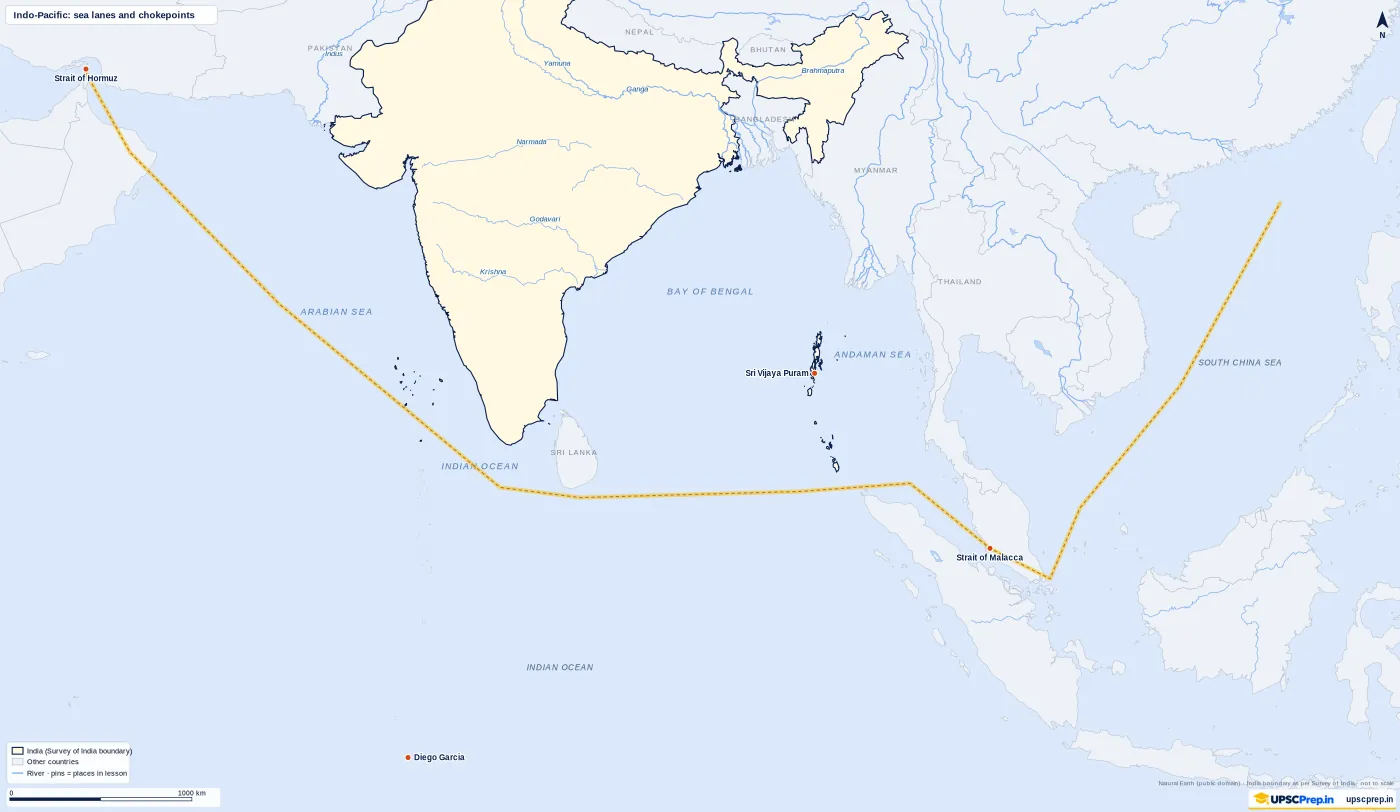
- Geography: from the east coast of Africa to the western Pacific, including vital chokepoints such as Hormuz, Bab-el-Mandeb and Malacca.
- ASEAN centrality: India sees ASEAN-led forums like the East Asia Summit as the region's core institutions.
- IPOI pillars: seven areas, including maritime security, maritime ecology, maritime resources, capacity building, disaster risk reduction, science and technology, and trade and transport connectivity.
- Inclusiveness: India's vision formally welcomes all countries, unlike stricter "containment" ideas.
- Linked to SAGAR: India's Indian Ocean policy of Security and Growth for All in the Region (2015).
Why it matters for UPSC
The Indo-Pacific is a core theme in GS2 questions on India's relations with the US, Japan, Australia and ASEAN, maritime security and the Quad. This page is a quick reference; the deep-dive lesson covers each partnership in detail.
Connections across the syllabus
- Quad: India, the US, Japan and Australia cooperate on maritime awareness, health, technology and infrastructure.
- Act East Policy: India's outreach to Southeast and East Asia since 2014, building on Look East (1991).
- Andaman and Nicobar Islands: India's tri-service command near the Strait of Malacca gives it a strategic position.
- Island states: partnerships with Mauritius, Seychelles, Sri Lanka and Maldives.
- France: a resident Indian Ocean power through Réunion; India–France cooperation includes joint patrols.
- Economy: the Indo-Pacific Economic Framework for Prosperity (IPEF, 2022), which India joined except for the trade pillar.
Recent developments
India continues to expand naval deployments, logistics agreements and coastal radar networks with partners. It promotes Information Fusion Centre–Indian Ocean Region (IFC-IOR) in Gurugram for maritime domain awareness and has signed hydrography and white shipping agreements with several countries. The Philippines bought BrahMos missiles from India, a sign of growing defence ties in Southeast Asia.
Timeline
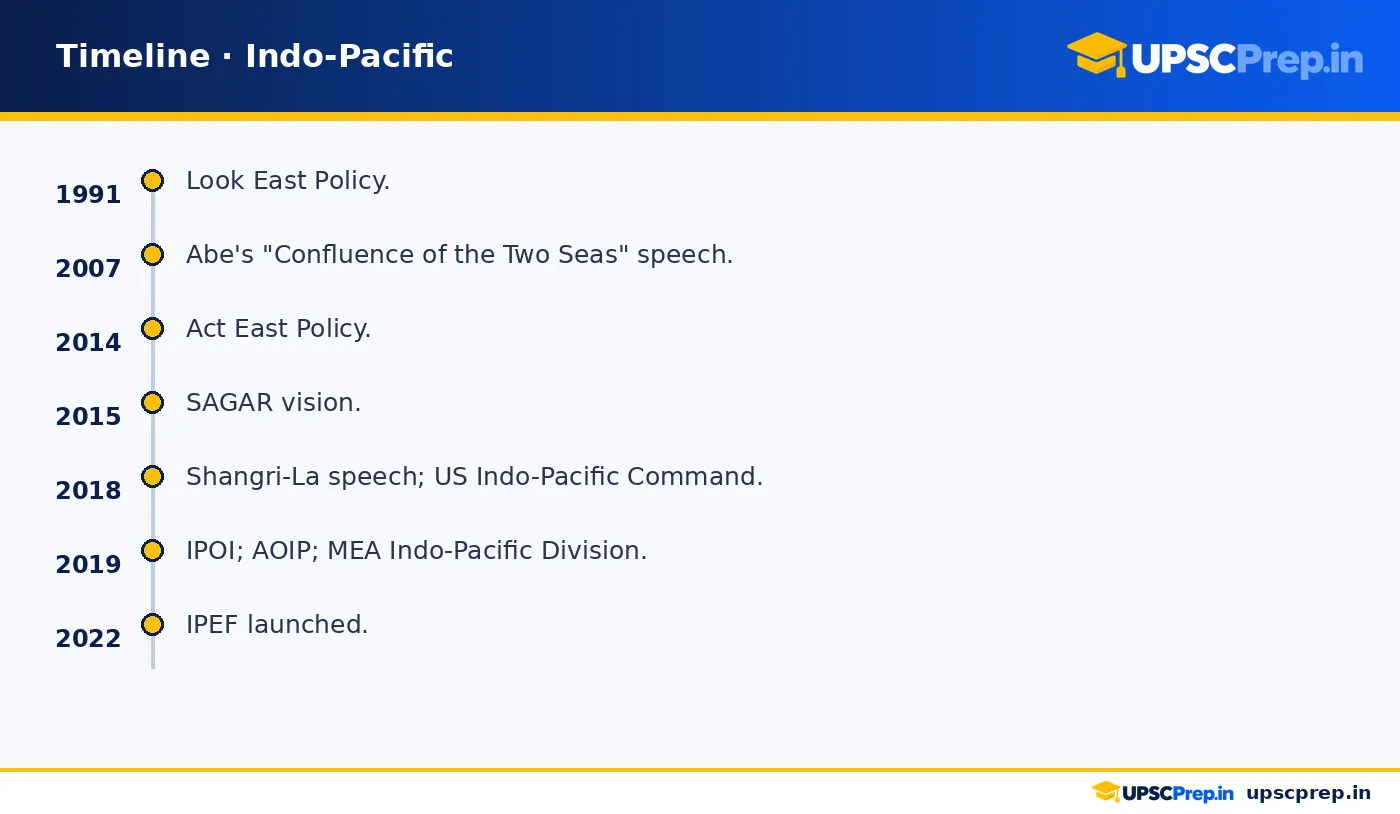
- 1991: Look East Policy.
- 2007: Abe's "Confluence of the Two Seas" speech.
- 2014: Act East Policy.
- 2015: SAGAR vision.
- 2018: Shangri-La speech; US Indo-Pacific Command.
- 2019: IPOI; AOIP; MEA Indo-Pacific Division.
- 2022: IPEF launched.
Using this term in answers
Maritime chokepoints: the map shows why the Strait of Malacca matters. A large share of China's oil imports passes through it, a vulnerability sometimes called the "Malacca dilemma," while India's Andaman and Nicobar Islands sit near its western entrance. Chokepoints at Hormuz and Bab-el-Mandeb matter for India's energy and trade with the Gulf and Europe.
Blue economy: use the IPOI's ecology and resources pillars to link the Indo-Pacific with fisheries, deep-sea mining, marine pollution and climate change.
Essays: the Indo-Pacific shows how geography is reimagined by politics: the same oceans were seen as separate regions until the balance of power changed. It also shows India moving from a continental mindset towards being a maritime power.
Answer tip: in Mains, mention concrete steps such as logistics agreements with the US, France, Australia and Japan, naval exercises like Malabar, and capacity building for island states, rather than repeating slogans.
Map
Common misconceptions
- "Indo-Pacific means the same thing for every country." Definitions and priorities vary widely.
- "India's Indo-Pacific vision is anti-China." India officially describes it as inclusive and not aimed at any country.
- "The Quad and the Indo-Pacific are the same." The Quad is one grouping working within the region.
- "India joined all IPEF pillars." India stayed out of the trade pillar.
Prelims facts
- Shangri-La Dialogue speech: 2018.
- IPOI: 2019, seven pillars.
- AOIP: 2019.
- IFC-IOR: Gurugram, 2018.
- Indo-Pacific Command: US, renamed 2018.
Mains angle
Discuss how the Indo-Pacific frame helps India extend its strategic space beyond South Asia, balance China's influence and strengthen partnerships, while keeping strategic autonomy. Critically assess the gap between India's vision of inclusiveness and the security-focused approach of some partners, and the capacity constraints of the Indian Navy.
PYQ trend
2 UPSC Prelims questions in our database (3976 questions, 2022–2026) mention this term.
Latest questions:
- UPSC Prelims 2026: The Chancellor of the Federal Republic of Germany visited India in January, 2026. Which of the following…
- UPSC Prelims 2022: Consider the following statements : Which of the statements given above are correct ? ["Vietnam has been one…
FAQs
What is the Indo-Pacific?
What is India's Indo-Pacific vision?
What is the IPOI?
Who first used the idea in a speech in India?
Why does the Indo-Pacific matter for India?
Last reviewed: 23 October 2026 · Original UPSCPrep.in content.