PCPNDT Act
Also: Pre-Conception and Pre-Natal Diagnostic Techniques (Prohibition of Sex Selection) Act, 1994, PNDT Act
Background and evolution
From the late 1970s, amniocentesis and later ultrasound made it possible to determine foetal sex. Combined with strong son preference, this led to the spread of sex-selective abortion, especially in north-western India. Maharashtra passed the first state law regulating prenatal diagnosis in 1988 after campaigns by women's groups and health activists.
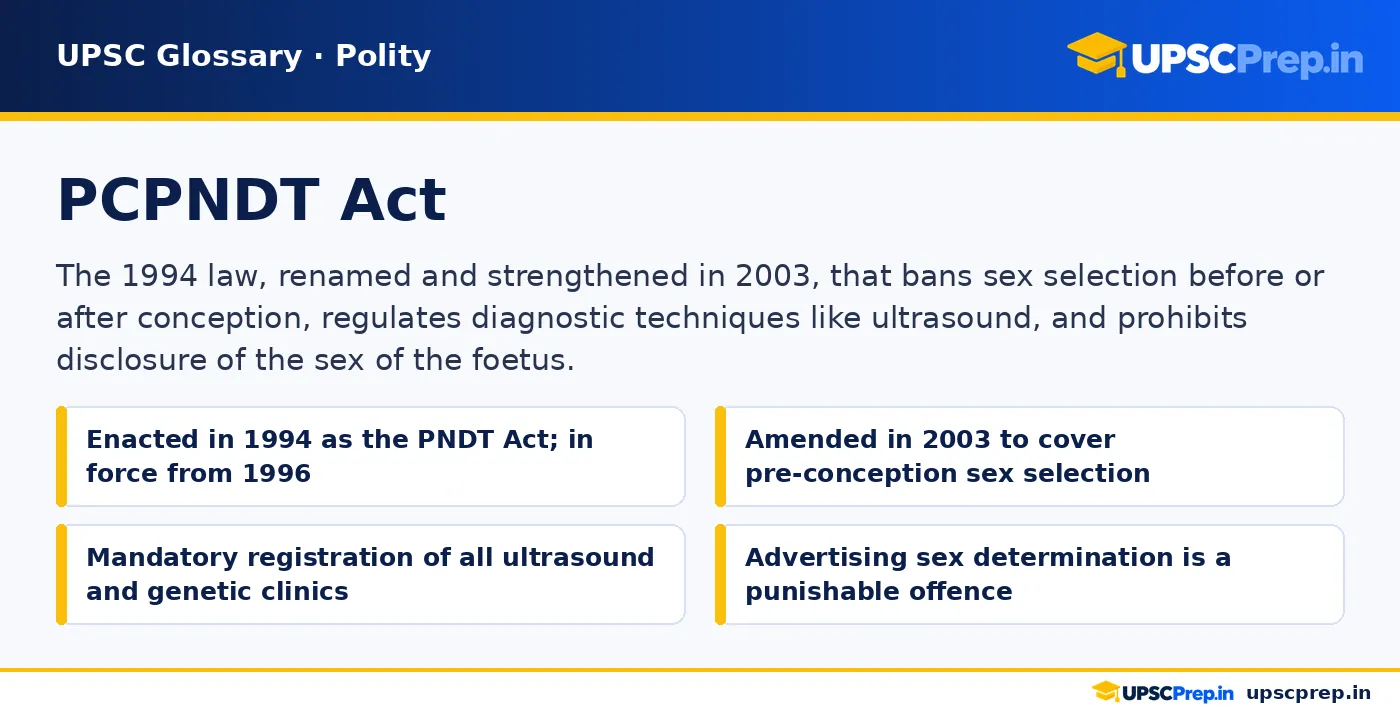
Parliament passed the Pre-Natal Diagnostic Techniques (Regulation and Prevention of Misuse) Act in 1994, which came into force in 1996. Enforcement was weak, and the 2001 Census showed a further decline in the child sex ratio. In CEHAT v. Union of India (2001), a public interest petition by health and women's groups, the Supreme Court issued directions for implementation. In 2003, the Act was amended and renamed to cover pre-conception techniques, such as sperm sorting, and to bring ultrasound machines clearly under regulation.
Key features and provisions
- Prohibition of sex selection: no person may conduct or aid sex selection on a woman or man, or both, or on any tissue, embryo or gametes.
- Regulation of techniques: prenatal diagnosis is allowed only for specified conditions, such as chromosomal abnormalities, genetic metabolic diseases and congenital anomalies.
- No disclosure: the sex of the foetus may not be communicated by words, signs or any other method.
- Registration: all genetic counselling centres, laboratories, clinics and ultrasound facilities must be registered, and sale of machines is limited to registered bodies.
- Records: detailed records, including Form F for every ultrasound on pregnant women, must be maintained.
- Authorities: a Central Supervisory Board chaired by the Union Health Minister, State Supervisory Boards and Appropriate Authorities at state and district levels.
- Penalties: imprisonment of up to three years and a fine for a first offence, with higher penalties for repeat offences; registered medical practitioners may have their registration suspended or cancelled.
- Presumption: a woman undergoing sex selection is presumed to have been compelled by her husband or relatives, unless proved otherwise.
You've read your 3 free glossary pages this month
Create a free account to read 5 full pages a month, or upgrade for unlimited access. The definition above, the A–Z index and the pop-up definitions in lessons stay free.
Last reviewed: 23 October 2026 · Original UPSCPrep.in content.