PM-KISAN
Also: Pradhan Mantri Kisan Samman Nidhi, PM Kisan
Background and evolution
The economic case for direct transfers rests on the idea that farmers know best how to spend support money, whether on seeds, fertiliser, labour or household needs, and that cash avoids the waste and distortions of subsidising particular inputs. Critics respond that a flat payment of ₹6,000 is small relative to cultivation costs and does little for the poorest rural households, who often do not own land.
Indian farmers face low and uncertain incomes because of small landholdings, price swings and climate risks. Traditional support came through input subsidies (fertiliser, power, water), minimum support prices for some crops, and loan waivers announced by states. These tools are costly, distort crop choices or benefit only some farmers. States such as Telangana, with its Rythu Bandhu scheme (2018), and Odisha, with KALIA, experimented with direct cash support per acre or per farmer.
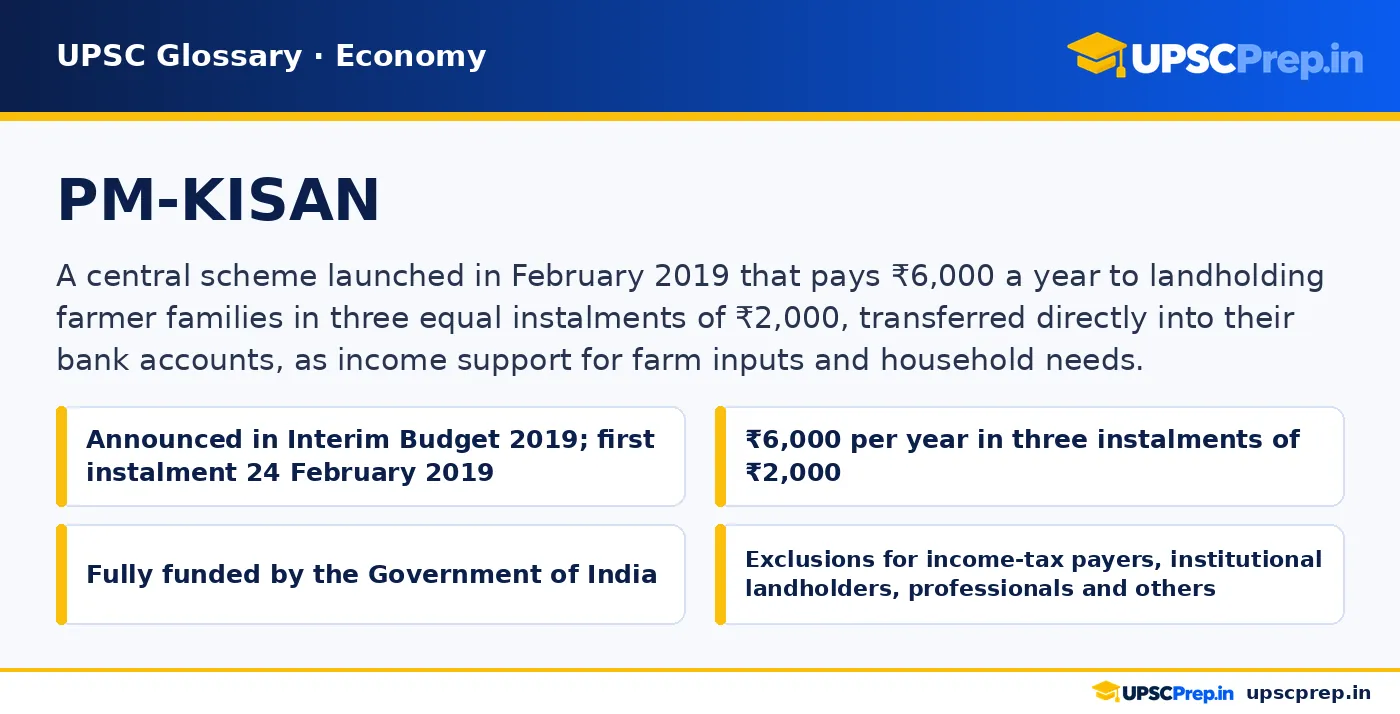
The Centre announced PM-KISAN in the 2019 Interim Budget, initially for small and marginal farmers with up to two hectares, and extended it to all landholding farmer families later that year. The first instalment was transferred at Gorakhpur in February 2019. Payment uses the Direct Benefit Transfer system, with Aadhaar seeding and, more recently, e-KYC and land record verification to remove ineligible beneficiaries. This page treats PM-KISAN as an experiment in unconditional income transfers to farmers, rather than a farm-price policy.
Key features and provisions
- Eligibility: families (husband, wife and minor children) owning cultivable land as per state land records.
- Exclusions: institutional landholders; constitutional post holders; serving or retired officers (except some lower grades); income-tax payers; professionals such as doctors, engineers and lawyers; and pensioners above a threshold.
- Payment cycle: three instalments per year covering April–July, August–November and December–March periods.
- Verification: state governments identify beneficiaries; land seeding, Aadhaar-based payment and e-KYC are mandatory.
- Portal and app: farmers can self-register, check status and update details.
- Linkages: beneficiaries are targeted for Kisan Credit Cards and other schemes.
Why it matters for UPSC
The scheme is often compared with the idea of a universal basic income, which the Economic Survey 2016–17 discussed as an alternative to many overlapping welfare schemes. PM-KISAN is not universal, since it targets landholding farmers, and its amount is modest, but it shares the core features of unconditional cash paid directly to bank accounts. Evidence from surveys suggests that farmers use the money mainly for seeds, fertiliser and household needs, especially when instalments arrive close to sowing seasons. Researchers have also found that payments can reduce reliance on informal moneylenders for small, short-term needs, though the amount is too small to change investment decisions significantly. Comparing it with Rythu Bandhu, which pays per acre and so benefits larger landowners more, and with KALIA, which tried to include landless households, is a useful way to discuss targeting choices.
The scheme is central to debates on farm income support, cash transfers versus subsidies, and targeting. It is one of the largest direct benefit transfer programmes in the world and shows how digital infrastructure can deliver payments at scale. It also raises questions about excluding tenant farmers and landless labourers, who often are the poorest in rural areas.
Connections across the syllabus
- Direct Benefit Transfer: relies on Jan Dhan accounts, Aadhaar and mobile numbers.
- Land records: accuracy of digitised records determines who benefits.
- Fiscal policy: annual spending of around ₹60,000 crore is a significant part of the agriculture budget.
- Rural demand: timely payments support spending on inputs and consumption.
- Federalism: some states initially delayed data verification, reducing coverage.
Recent developments
A saturation drive has been run to add eligible farmers who were missed, using village-level camps and the mobile app with face authentication.
The government has continued releasing instalments regularly, with around 9–10 crore farmers receiving each recent instalment after verification drives removed ineligible names. There have been proposals and demands to raise the annual amount, and to cover tenant farmers, though the design remains unchanged.
Using this term in answers
- Fiscal angle: a predictable, budgeted transfer is easier to account for than open-ended input subsidies.
- Data angle: the scheme forced states to clean and digitise land records, a benefit beyond the payments themselves.
- Political economy angle: cash transfers create a direct link between the Centre and farmers.
- Welfare design angle: unconditional cash gives farmers flexibility but is small relative to costs.
- Equity angle: landowners benefit while tenants and labourers do not.
- Governance angle: digital verification reduces leakage but may exclude genuine farmers with record errors.
Common misconceptions
- "PM-KISAN pays per acre." It is a flat amount per family regardless of land size.
- "Tenant farmers are covered." Only landholding families with land in their names are eligible.
- "States share the cost." The Centre funds it fully.
- "It is a loan." It is a direct income transfer.
Prelims facts
- Beneficiary families are defined as husband, wife and minor children.
- e-KYC is mandatory for receiving instalments.
- ₹6,000 per year in three instalments.
- Launched at Gorakhpur on 24 February 2019.
- Ministry of Agriculture and Farmers Welfare.
- Telangana's Rythu Bandhu and Odisha's KALIA were earlier state schemes.
Mains angle
Include evidence from surveys on how farmers use the money.
Assess PM-KISAN as farm income support. Credit its scale, simplicity and digital delivery, and discuss limits: small amount, exclusion of tenants and landless workers, dependence on land records, and limited impact on productivity. Suggest including tenant farmers through state tenancy records, linking support to climate-resilient practices and gradually rationalising distorting input subsidies.
PYQ trend
No Prelims question in our database mentions this term directly; it is mainly a Mains theme.
FAQs
How much does PM-KISAN pay?
Who is eligible?
Who funds PM-KISAN?
Are tenant farmers covered?
How is money transferred?
Last reviewed: 23 October 2026 · Original UPSCPrep.in content.