Direct Benefit Transfer
Also: DBT, direct cash transfer
Background and evolution
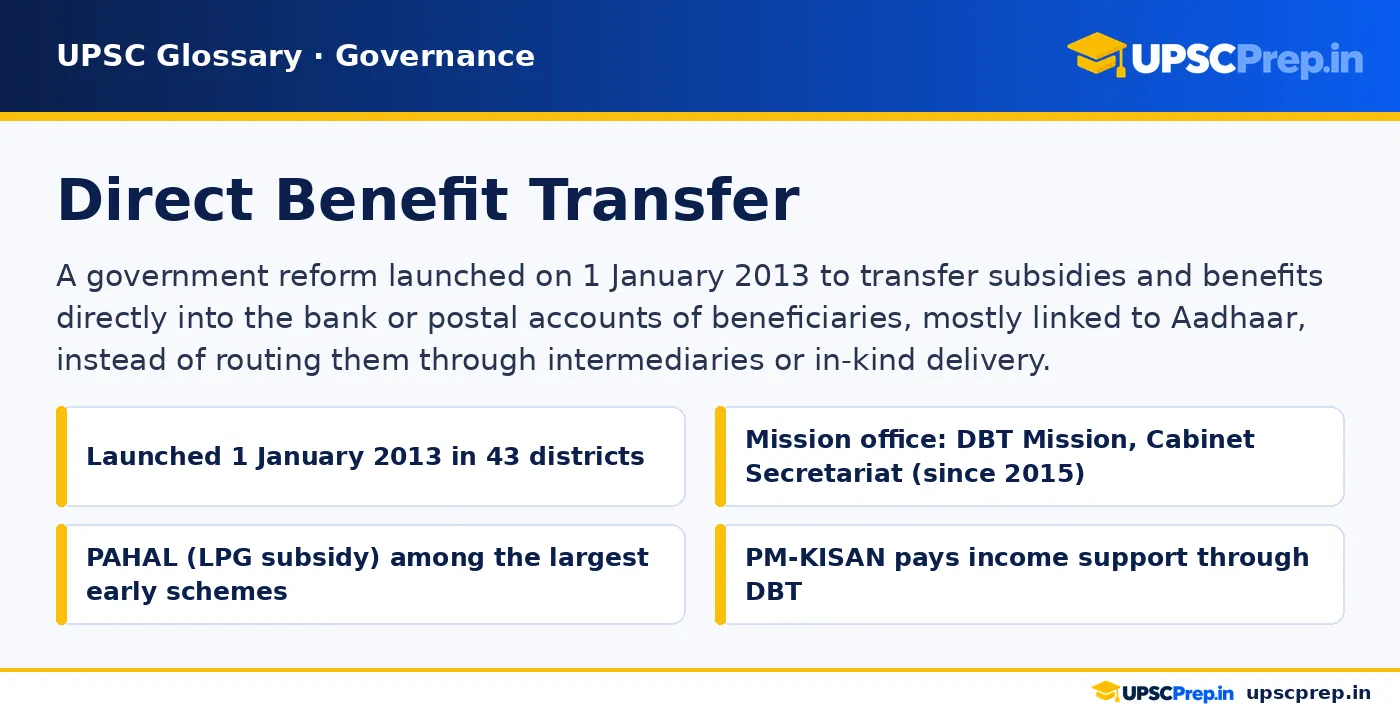
Leakages in welfare delivery have been a long-standing concern in India. Former Prime Minister Rajiv Gandhi is often quoted as saying in 1985 that only about 15 paise of every rupee spent reached the intended beneficiary. Subsidies flowed through layers of officials, dealers and contractors, creating opportunities for diversion, delays and corruption. In-kind subsidies, such as kerosene and fertiliser at below-market prices, also created incentives for black markets.
The DBT programme began on 1 January 2013, initially for scholarships and some social security pensions in selected districts. It gained momentum after the spread of Jan Dhan accounts and Aadhaar authentication from 2014, and the DBT Mission was moved to the Cabinet Secretariat in 2015 to coordinate across ministries. Schemes such as the PAHAL LPG subsidy, MGNREGA wages, pensions, scholarships and later PM-KISAN were brought onto the DBT platform.
Key features and provisions
- Cash transfers: money sent directly to bank accounts, such as PM-KISAN or pensions.
- In-kind transfers: benefits such as food grains, delivered after biometric authentication at the point of sale.
- Aadhaar Payment Bridge: maps Aadhaar numbers to bank accounts for routing.
- Public Financial Management System (PFMS): tracks fund flows from the Centre to beneficiaries.
- DBT Bharat portal: reports scheme-wise data on transfers.
- Beneficiary databases: digitised, de-duplicated lists of eligible people.
- Electronic payment: reduces handling of cash by intermediaries.
Why it matters for UPSC
DBT is a key governance reform, so it is tested in Prelims (launch, mission, schemes) and in Mains on leakages, financial inclusion, e-governance, cash versus in-kind support, and federalism. It is also a strong example for GS4 answers on transparency and probity.
Connections across the syllabus
- JAM trinity: Jan Dhan, Aadhaar and mobile enable DBT.
- Fiscal policy: better targeting reduces subsidy costs.
- Agriculture: fertiliser DBT pays companies after sales are authenticated at retail points.
- PDS: debates on replacing grain with cash, piloted in some UTs.
- Women's empowerment: transfers to women's accounts, such as in some state schemes, can strengthen their decision-making.
- Social audit: helps verify that transfers reached the right people.
Recent developments
States have launched large DBT-based income support schemes, particularly for women, raising debates on fiscal sustainability and the balance between cash support and public services.
Timeline
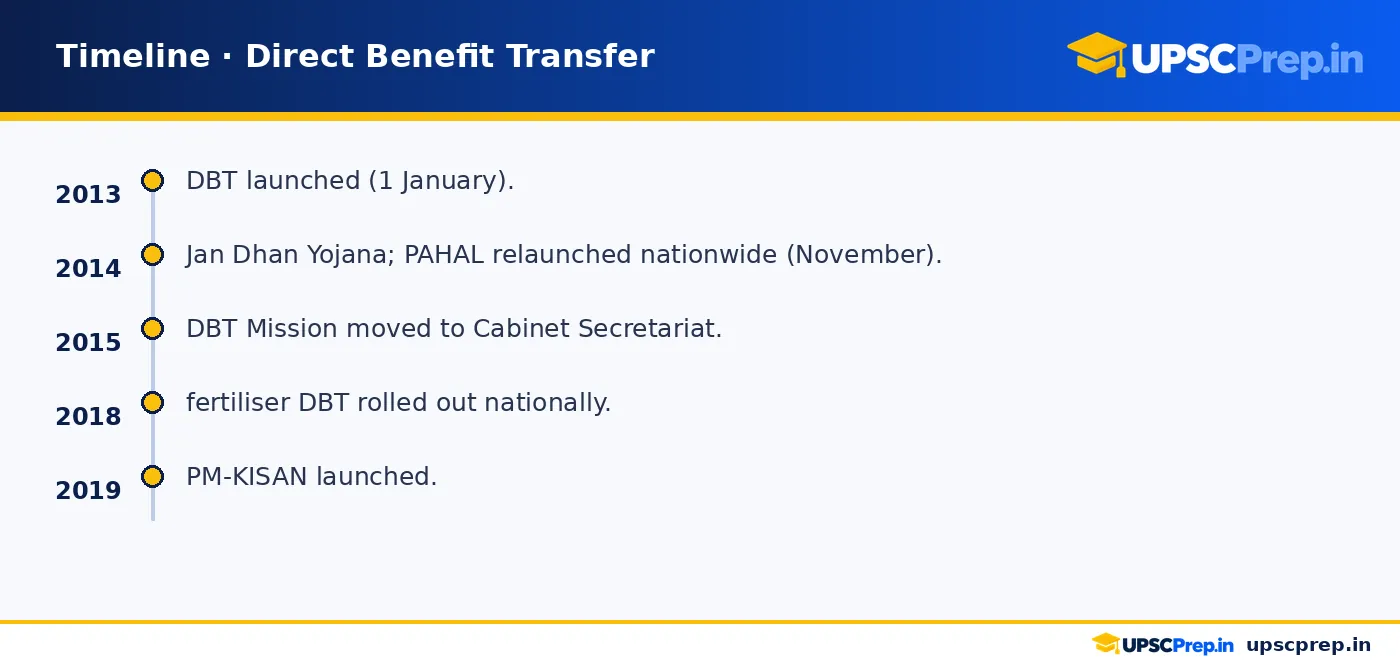
- 2013: DBT launched (1 January).
- 2014: Jan Dhan Yojana; PAHAL relaunched nationwide (November).
- 2015: DBT Mission moved to Cabinet Secretariat.
- 2018: fertiliser DBT rolled out nationally.
- 2019: PM-KISAN launched.
Using this term in answers
Federal angle: many DBT schemes are run by states, and they increasingly use their own databases and payment systems. Coordination with central systems avoids duplication.
Gender angle: paying benefits into women's accounts can increase their control over household money, though evidence shows that access to the account must be accompanied by financial literacy.
Cash versus kind angle: supporters of cash argue that it respects choice, reduces administrative costs and avoids the leakages of physical supply chains. Supporters of in-kind food argue that grain protects against inflation, is more likely to be consumed by the whole family, and supports farmers through procurement. Pilots of cash for food in Chandigarh, Puducherry and parts of Dadra and Nagar Haveli showed mixed results, with some families struggling to access cash and markets. The best policy may differ by region, depending on banking access and market prices.
Evidence angle: studies of DBT in LPG and fertiliser found that authentication reduced diversion to commercial users, but also revealed that savings estimates depend on assumptions. Good evaluation separates the effect of DBT itself from price changes and other policy shifts.
Last-mile angle: in remote villages, the nearest bank branch may be far away. Business correspondents with micro-ATMs, India Post Payments Bank and AePS help people withdraw money near home, but agents sometimes charge illegal fees or misuse biometrics. Regulation of agents and awareness among beneficiaries are therefore part of making DBT work.
Accountability angle: DBT creates detailed digital records of who received what and when. Publishing anonymised data and allowing public scrutiny through social audits and the RTI Act can strengthen accountability further, provided that personal privacy is protected.
Grievance angle: when a payment fails, beneficiaries often do not know whether the problem lies with the bank, the Aadhaar seeding or the department. A single, simple grievance window with time-bound resolution would greatly improve trust in the system.
Tracking such grievances also helps departments spot systemic faults early.
Common misconceptions
- "DBT means only cash." It also covers in-kind benefits with authentication.
- "DBT removes all leakages." It reduces some but can cause exclusion; also, last-mile cash withdrawal can still involve intermediaries.
- "DBT is a single scheme." It is a mechanism used by many schemes.
- "DBT needs Aadhaar for everything." Aadhaar seeding is used widely but alternatives exist for those without it.
Prelims facts
- Launched 1 January 2013.
- DBT Mission placed in the Cabinet Secretariat.
- PAHAL is the DBT scheme for LPG subsidy.
- PFMS tracks fund release and use.
Mains angle
Discuss benefits (reduced leakages, faster payments, transparency, financial inclusion, data for policy) and challenges (exclusion errors, poor banking access in remote areas, payment failures due to wrong account details, cash-out difficulties, digital literacy). Discuss the cash versus in-kind debate, especially for food. Suggest last-mile banking correspondents, grievance redressal, choice for beneficiaries, and periodic social audits.
PYQ trend
1 UPSC Prelims question in our database (3976 questions, 2026–2026) mention this term.
Latest questions:
- UPSC Prelims 2026: Which of the following statements with regard to GenomeIndia Project is/are correct ? Select the answer using…
FAQs
What is Direct Benefit Transfer?
When did DBT start?
Which office coordinates DBT?
What is PAHAL?
What are the challenges of DBT?
Last reviewed: 23 October 2026 · Original UPSCPrep.in content.