GS1 › Indian Geography
Revision note: Climate, Soils and Natural Vegetation
- SW Monsoon June–Sept brings ~75% of the rainfall; Tamil Nadu gets its rain in Oct–Dec
- Black soil = cotton, moisture retention; laterite = leaching
- Tropical deciduous = most widespread forest
Indian Monsoon – Simple Explanation
Why India gets most of its rain between June and September.
Basic idea
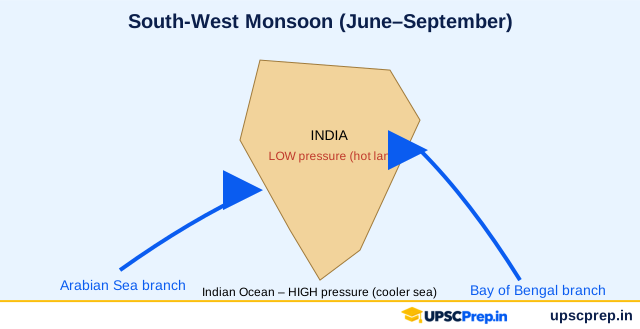
In summer the land heats faster than the sea. A low-pressure area forms over north-west India, and moist winds from the Indian Ocean flow in – the South-West Monsoon (June–September).
Key factors
- Differential heating of land and sea
- Shift of the ITCZ (Inter-Tropical Convergence Zone) northwards
- Tibetan Plateau heating and the Tropical Easterly Jet
- El Niño usually weakens the monsoon; positive IOD (Indian Ocean Dipole) usually helps it
Two branches
- Arabian Sea branch – heavy rain on the Western Ghats
- Bay of Bengal branch – rain in the North-East; Mawsynram/Cherrapunji are among the wettest places

Source: https://upscprep.in/upsc/gs1/indian-geography/climate-soils-and-natural-vegetation/ · UPSCPrep.in