Fundamental Rights, Directive Principles and Duties
GS2 · Polity and the Constitution
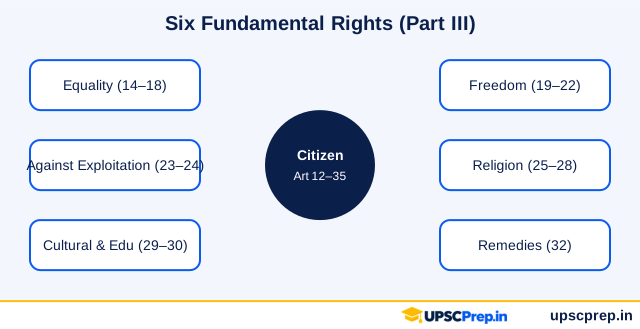
Fundamental Rights (Part III, Articles 12–35)

| Right | Articles | Highlights |
|---|---|---|
| Equality | 14–18 | Equality before law; no discrimination; equal opportunity in public jobs; untouchability abolished (17); titles abolished (18) |
| Freedom | 19–22 | Six freedoms in Art. 19; protection in respect of conviction (20); life and personal liberty (21); education 6–14 years (21A); safeguards on arrest (22) |
| Against exploitation | 23–24 | Ban on trafficking and forced labour; no child below 14 in hazardous work |
| Freedom of religion | 25–28 | Profess, practise, propagate; manage religious affairs |
| Cultural and educational | 29–30 | Minorities can set up and run educational institutions |
| Constitutional remedies | 32 | Go directly to the Supreme Court |
- Writs: habeas corpus (produce the body – against illegal detention), mandamus (we command – perform a duty), prohibition (stop a lower court), certiorari (quash an order), quo warranto (by what authority).
- The Supreme Court issues writs under Art. 32; High Courts under Art. 226 (their power is wider).
- Art. 20 and 21 cannot be suspended even in an emergency (44th Amendment, 1978).
- Art. 21 has been widened by courts to include privacy (Puttaswamy, 2017), clean environment, livelihood, shelter and more.
Directive Principles of State Policy (Part IV, Art. 36–51)
- Not enforceable by courts, but "fundamental in the governance of the country" (Art. 37).
- Examples: equal pay for equal work (39(d)), free legal aid (39A), village panchayats (40), uniform civil code (44), early childhood care (45), protection of the environment (48A), separation of the judiciary from the executive (50), international peace (51).
- Minerva Mills (1980): harmony and balance between FRs and DPSPs is part of the basic structure.

Fundamental Duties (Part IVA, Art. 51A)
- Added by the 42nd Amendment (1976) on the recommendation of the Swaran Singh Committee. There were originally 10 duties.
- The 11th duty – parents to provide education to children aged 6–14 – was added by the 86th Amendment (2002).
- Like DPSPs, they are not directly enforceable.
Background: why rights were written into the Constitution
The national movement demanded rights early – the Constitution of India Bill (1895), the Nehru Report (1928) and the Karachi Resolution (1931). Experience of colonial repression (the Rowlatt Act) made leaders insist that rights must be enforceable against the state. The Constitution therefore puts Fundamental Rights (Part III, Arts. 12–35) in a justiciable form. It adds Directive Principles (Part IV, Arts. 36–51) as goals for the state. Fundamental Duties (Part IVA, Art. 51A) were added later.
Fundamental Rights – a working guide
| Right | Articles | Key points |
|---|---|---|
| Equality | 14–18 | Equality before law and equal protection (14); no discrimination (15); equality in public employment (16); abolition of untouchability (17); abolition of titles (18) |
| Freedom | 19–22 | Six freedoms in Art. 19 (speech, assembly, association, movement, residence, profession), with "reasonable restrictions"; protection in conviction (20); life and personal liberty (21); right to education (21A, 2002); protection against arbitrary arrest (22) |
| Against exploitation | 23–24 | No trafficking or forced labour; no child labour in factories, mines or hazardous work (below 14) |
| Freedom of religion | 25–28 | Conscience and free practice; management of religious affairs; no tax for promoting a religion; no religious instruction in state-funded institutions |
| Cultural and educational | 29–30 | Protect language, script and culture; minorities' right to run educational institutions |
| Constitutional remedies | 32 | Direct approach to the Supreme Court; writs. Ambedkar called it the "heart and soul" of the Constitution |
Writs:
- Habeas corpus – produce the body; against illegal detention;
- mandamus – "we command"; directs a public authority to perform its duty;
- prohibition – stops a lower court from exceeding jurisdiction;
- certiorari – quashes an order already passed;
- quo warranto – asks by what authority a person holds a public office.
Who can claim them? Some rights are only for citizens (15, 16, 19, 29, 30). Others are for all persons, including foreigners (14, 20, 21, 21A, 22, 23–28).
Art. 20 and 21 cannot be suspended even during an emergency (44th Amendment).
How Article 21 grew – from narrow to broad
- A.K. Gopalan (1950): narrow reading – "procedure established by law" means any procedure enacted by law.
- Maneka Gandhi (1978): the procedure must be "just, fair and reasonable"; Articles 14, 19 and 21 are linked (the "golden triangle").
Later cases read many rights into Article 21: livelihood (Olga Tellis 1985), clean environment (Subhash Kumar 1991), speedy trial, legal aid, shelter, health, privacy (K.S. Puttaswamy, 2017, nine judges), dignity in death (Common Cause 2018 – passive euthanasia), and sexual orientation (Navtej Johar 2018).
Directive Principles (DPSP)
Nature: not enforceable in courts (Art. 37), but "fundamental in the governance of the country".
| Type | Examples |
|---|---|
| Socialist | Art. 38 (welfare, reduce inequalities); 39 (adequate livelihood, equal pay, prevent concentration of wealth; 39A free legal aid); 41 (work, education, public assistance); 42 (maternity relief); 43 (living wage) |
| Gandhian | Art. 40 (village panchayats); 43 (cottage industries); 46 (welfare of SCs/STs and weaker sections); 47 (prohibition of intoxicating drinks); 48 (cow protection) |
| Liberal-intellectual | Art. 44 (Uniform Civil Code); 45 (early childhood care); 48A (environment); 49 (monuments); 50 (separation of judiciary from executive); 51 (international peace) |
Conflict and harmony between FRs and DPSP
| Case | Holding |
|---|---|
| Champakam Dorairajan (1951) | FRs prevail over DPSP → the 1st Amendment |
| Golaknath (1967) | Parliament cannot amend FRs |
| Kesavananda Bharati (1973) | Parliament can amend, but not the basic structure |
| Minerva Mills (1980) | Balance between FRs and DPSP is part of the basic structure; they are complementary |
Fundamental Duties
Added by the 42nd Amendment (1976) on the Swaran Singh Committee's recommendation, there were originally ten duties. The 86th Amendment (2002) added the eleventh: the duty of parents and guardians to provide education to children aged 6–14 (Art. 51A(k)). Inspired by the USSR, the duties are not directly enforceable, but courts use them to interpret laws (the Verma Committee 1999 identified legal provisions that support them).
Case study: the right to privacy (Puttaswamy, 2017)
The challenge to Aadhaar raised a question: is privacy a fundamental right? A nine-judge bench unanimously held that privacy is intrinsic to Art. 21 and Part III. It set a three-part test for limiting rights: legality, legitimate aim, and proportionality. Effects: the 2018 Aadhaar judgment limited the scheme's mandatory use, and this led eventually to the Digital Personal Data Protection Act, 2023.
Common misconceptions
- "Fundamental Rights are absolute." – Most allow reasonable restrictions (e.g. Art. 19(2)–(6)).
- "DPSP are useless because they are non-justiciable." – Many laws come from them: MGNREGA (Art. 41), the Panchayati Raj amendments (Art. 40), RTE (Art. 45), and free legal aid (Art. 39A).
- "Fundamental Duties were in the original Constitution." – They were added in 1976.
How UPSC asks it
Prelims frequently tests which article covers what, who can claim which right, writs, and DPSP classification. Mains themes include the expansion of Article 21, the relationship between FRs and DPSP, the Uniform Civil Code, and the relevance of Fundamental Duties.
Mains answer framework
Q-type: "The Directive Principles are a mere manifesto of pious wishes. Critically examine."
- Intro: non-justiciable by Art. 37, yet "fundamental in governance".
- Criticism: no legal force; vague; some outdated (K.T. Shah called them "a cheque payable at the convenience of the bank").
- Counter: a moral compass; the basis of major laws; the Minerva Mills balance; courts use them to interpret rights.
- Conclusion: the "instrument of instructions" for building a welfare state.
- Art. 32 = "heart and soul" (Ambedkar); Art. 226 = High Court writs
- Art. 20 and 21 survive an emergency; Art. 21A by the 86th Amendment
- DPSP Art. 36–51 (non-justiciable); FDs Art. 51A (11 duties)