PM Gati Shakti
Also: Gati Shakti, PM Gati Shakti National Master Plan, NMP
Background and evolution
Logistics costs in India have been estimated in various studies at around 13–14% of GDP, though a later government-commissioned estimate put them lower, at about 8% of GDP. Whatever the exact figure, freight in India relies heavily on roads, which are costlier per tonne-kilometre than railways and waterways, and a shift in the transport mix is a central aim of the plan.
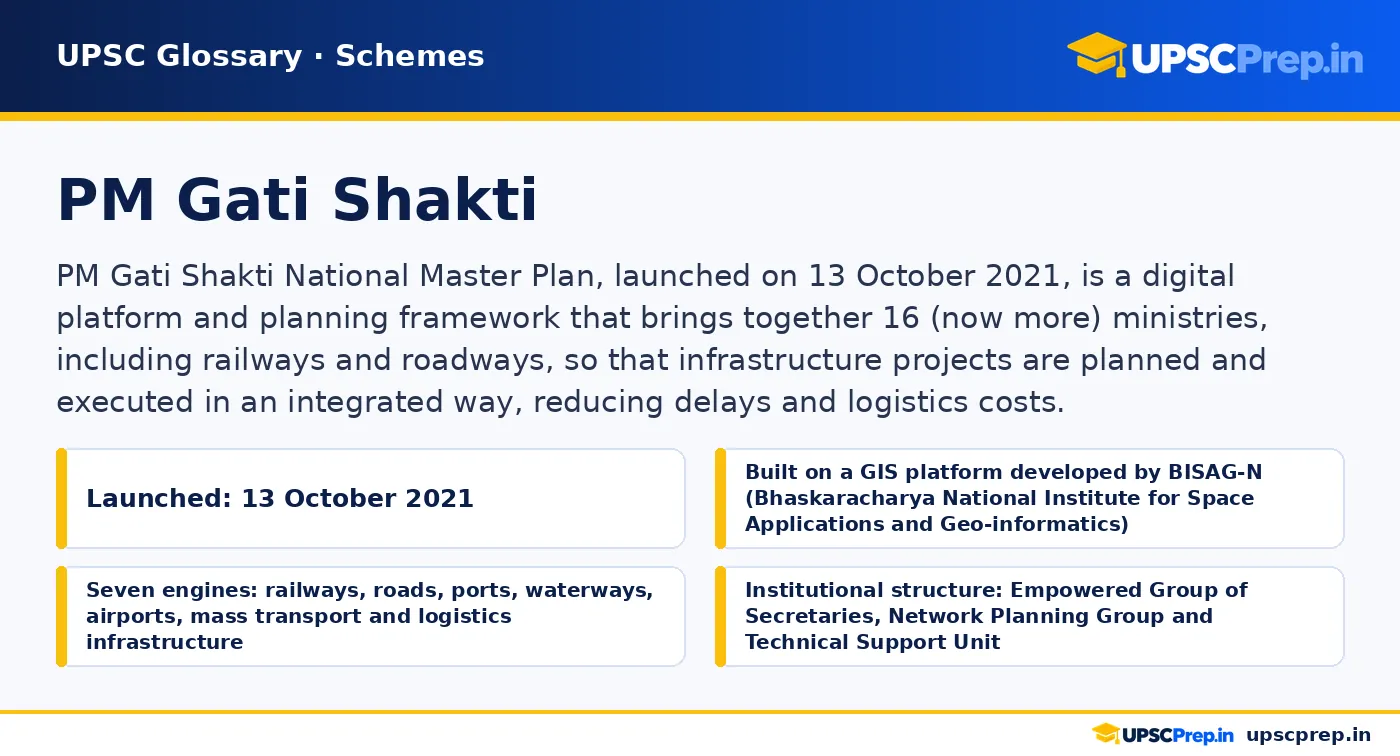
India's infrastructure was long planned in silos. A road might be built, then dug up to lay a gas pipeline, then again for fibre cables; a port might be expanded without a rail line to carry its cargo; an industrial park might lack power or water. Each ministry had its own plans and maps, and clearances were sought one by one. The result was delays, cost overruns and high logistics costs, estimated at well above the levels in many competing economies.
Gati Shakti aims to solve this coordination problem with data. It places hundreds of layers of information, such as existing roads, railways, pipelines, forest boundaries, land records, power lines and economic zones, on one map that all ministries and states can access. Planners can then see where new projects should go, which clearances will be needed, and which other agencies' work overlaps. This page treats Gati Shakti as a reform of how the state plans, rather than as a set of physical projects such as Bharatmala and Sagarmala, which have their own page.
You've read your 3 free glossary pages this month
Create a free account to read 5 full pages a month, or upgrade for unlimited access. The definition above, the A–Z index and the pop-up definitions in lessons stay free.
Last reviewed: 23 October 2026 · Original UPSCPrep.in content.