Indian Independence Act, 1947
Also: Independence Act 1947
Background and evolution
Once the Cabinet Mission Plan collapsed in 1946, communal violence spread from Calcutta to Noakhali, Bihar and Punjab. In February 1947 Prime Minister Clement Attlee announced that Britain would transfer power no later than June 1948. Lord Mountbatten arrived as Viceroy in March 1947 with a mandate to arrange the transfer quickly. After consultations, he concluded that partition was the only workable solution, and the plan announced on 3 June 1947 provided for the division of India, with provincial legislatures of Punjab and Bengal voting on partition, a referendum in the NWFP and Sylhet, and a boundary commission.
Mountbatten advanced the date of transfer to 15 August 1947. The British Parliament passed the Indian Independence Act within weeks, an unusually rapid process for a law of such importance. The boundary commissions under Sir Cyril Radcliffe drew the lines in Punjab and Bengal, and the awards were made public on 17 August 1947, two days after independence.
Key features and provisions
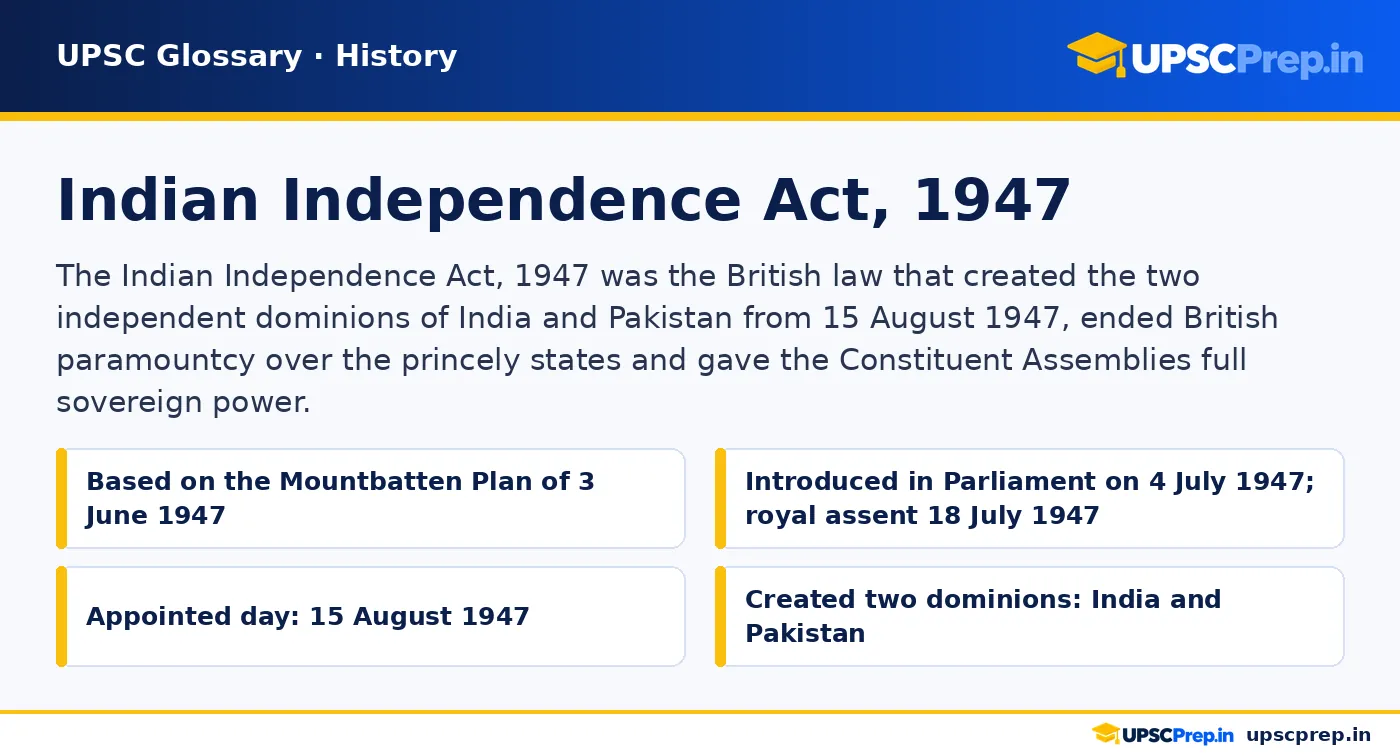
- Two dominions: India and Pakistan, each with full legislative authority, from 15 August 1947.
- Constituent Assemblies: each Assembly would act as the legislature of its dominion until a new constitution was framed, with power to repeal any British law, including the Act itself.
- Governors-General: each dominion would have a Governor-General appointed by the Crown on the advice of its cabinet; Mountbatten became India's, and Jinnah Pakistan's.
- End of paramountcy: British suzerainty over princely states lapsed, leaving them free in law to join either dominion or remain independent.
- End of British control: the British government would have no responsibility for India after the appointed day; the office of Secretary of State for India was abolished.
- Services and armed forces: arrangements were made for the division of the armed forces and the continuation of civil servants.
- Title: the British monarch dropped the title "Emperor of India".
You've read your 3 free glossary pages this month
Create a free account to read 5 full pages a month, or upgrade for unlimited access. The definition above, the A–Z index and the pop-up definitions in lessons stay free.
Last reviewed: 23 October 2026 · Original UPSCPrep.in content.